
7 Best OpenClaw Alternatives in 2026 (Safer & Zero-Setup)
OpenClaw is powerful but friction-heavy. An honest, by-use-case comparison of the best OpenClaw alternatives in 2026: by setup, security, cost, and who each is built for.
The best OpenClaw alternative depends on what kind of user you are: if you want zero-setup simplicity, a browser-based managed agent is the answer; if you want full control, another open-source framework is. OpenClaw is one of the most popular open-source AI agents in the world, but its local-first design comes with real friction: manual setup, security exposure, and unpredictable API costs. This guide compares the top OpenClaw alternatives in 2026 by who they're for, how they handle setup and security, and what they cost.
A note on transparency up front: Happycapy, included below, is our own product. Rather than crown it the winner of every category like most "alternatives" lists do, we've laid out an honest decision framework and pointed you to the right tool for each use case, including where Happycapy isn't the best fit.
Why People Look for OpenClaw Alternatives
People look for OpenClaw alternatives because, for all its power, it asks a lot of the user before it does anything useful. Three friction points come up again and again:
- Setup complexity. OpenClaw is local-first and CLI-driven. Getting it running means installing a recent Node.js, configuring API keys, and wiring up channels, commonly 30 to 60 minutes before your first task, and more to keep it running 24/7.
- Security exposure. Because it runs locally with broad access and no built-in approval step, a misread prompt can take destructive actions, and credentials are exposed to the model by design. Prompt injection from content it reads is a real, acknowledged risk.
- Unpredictable cost. The software is free, but agentic tasks are token-heavy. Users routinely report surprise API bills running well into the tens or hundreds of dollars a month.
None of this means OpenClaw is bad. It's genuinely powerful and endlessly extensible. It just means it's built for technical users who want to own the whole stack. Most people want the results without the maintenance.
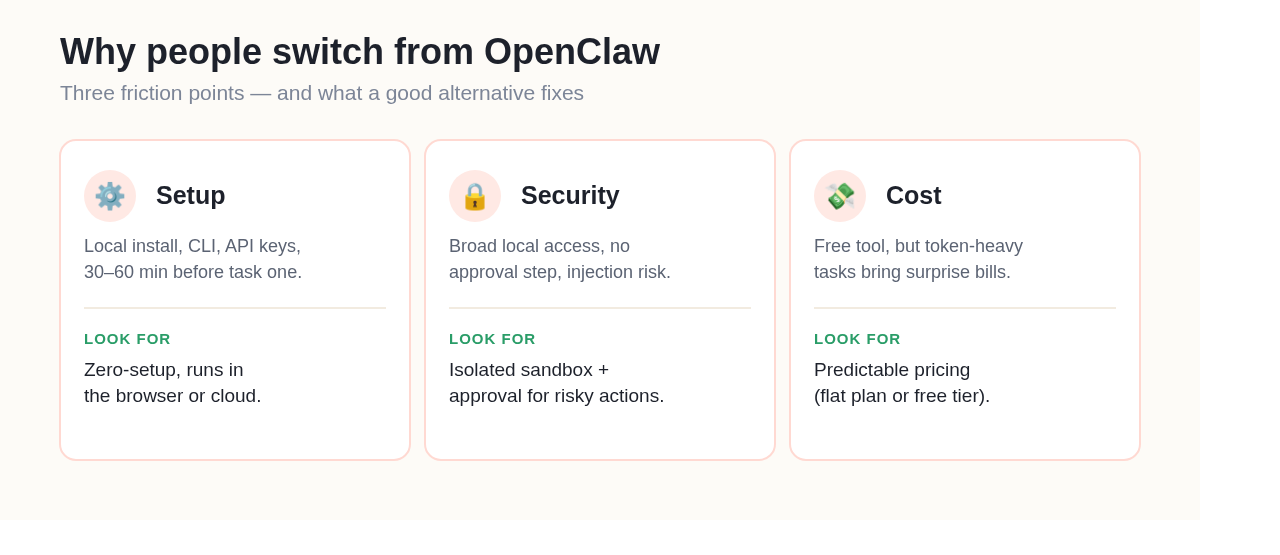 The three pain points that send people looking, and what a good alternative fixes.
What to Look for in an Alternative
A good OpenClaw alternative should remove at least one of those three pain points without taking away the agent's usefulness. When comparing options, weigh five things:
- Setup effort: can you start in seconds, or is there an install-and-configure step?
- Security model: does the agent run in an isolated sandbox, and is there an approval step for risky actions?
- Cost predictability: flat subscription, usage-based, or self-hosted infrastructure you manage?
- Who it's built for: non-technical users, developers, or both?
- Capability: can it actually take real actions across files, the web, and apps, or is it research-only?
The Best OpenClaw Alternatives at a Glance
| Tool | Type | Setup | Security model | Best for |
|---|---|---|---|---|
| OpenClaw (baseline) | Open-source, local-first | Install + configure (CLI) | Local access, no built-in approval | Developers who want full control |
| Happycapy | Managed, browser-based | None (runs in your browser) | Isolated cloud sandbox | Non-technical and technical users who want zero setup |
| Manus | Managed cloud agent | None | Cloud sandbox | Long-horizon autonomous tasks |
| Perplexity | Managed cloud agent | None | Cloud sandbox | Research-heavy workflows |
| Claude Code | Developer CLI / coding agent | Install | Local or sandbox | Developers in the Anthropic ecosystem |
| Open-source frameworks (e.g. Hermes Agent) | Open-source, self-hosted | Self-host | Configurable | Developers who still want OSS, but cleaner |
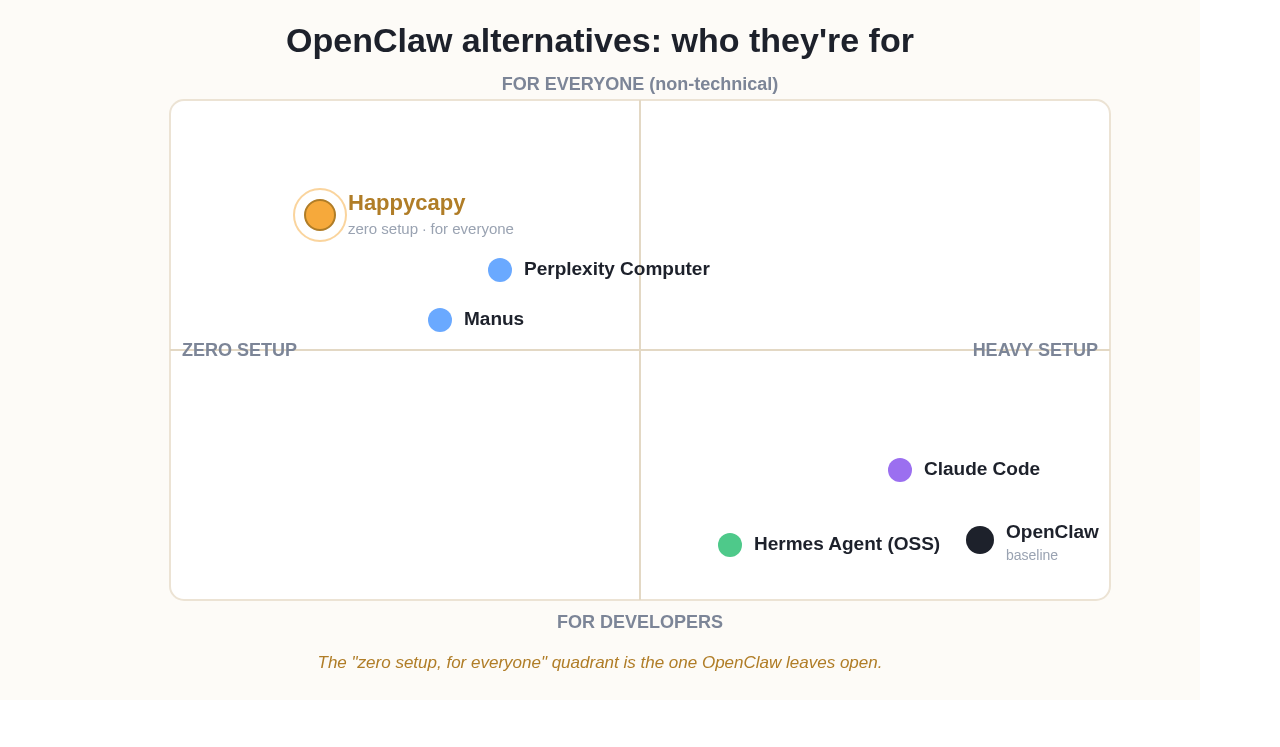 Mapped by setup effort and audience: the zero-setup, for-everyone quadrant is the gap OpenClaw leaves open.
The Alternatives, by Use Case
If you want zero setup: Happycapy
Happycapy is an agent-native computer that runs AI agents (including Claude Code and 150+ models) directly in your browser, with nothing to install. Agents work inside an isolated cloud sandbox, so a mistake or a malicious instruction can't reach your machine, and you watch the work happen on a visual desktop. It's aimed at the group OpenClaw underserves most: people who want an agent to do things without becoming a systems administrator first. (This is our product; we think it's the best fit for non-technical users and anyone who values zero setup, but read on for where other tools win.)
If you want autonomous cloud tasks: Manus
Manus is a polished managed agent built for long-horizon, autonomous work. Give it a multi-step goal and let it run in the cloud. It's a strong pick when you want hands-off execution of research-and-build tasks and don't need to run anything locally.
If you want research and monitoring: Perplexity
Perplexity leans into research-heavy, browser-based workflows. If most of what you want is to gather, synthesize, and monitor information from the web rather than take broad actions across your files and apps, it's a natural fit.
If you're a developer in the Anthropic ecosystem: Claude Code
Claude Code is a coding-focused agent that lives in your terminal (and now IDE and web). It's the strongest choice for software development specifically, and for developers who are comfortable with setup and want tight control over an agent working in a real codebase.
If you still want open source: Hermes Agent and others
If the appeal of OpenClaw was the open-source, self-hosted model, the answer isn't necessarily to leave that model. It's to pick a cleaner one. Open-source alternatives like Hermes Agent aim to keep local control while improving security hardening and setup. You still own the infrastructure, but with fewer rough edges.
How to Choose
Match the tool to the person, not the hype:
- Non-technical, want results now → a zero-setup managed agent like Happycapy.
- Want hands-off autonomous cloud runs → Manus.
- Mostly research and information work → Perplexity.
- Building software, comfortable with a terminal → Claude Code.
- Committed to open-source and self-hosting → a hardened OSS framework like Hermes Agent.
The honest summary: if OpenClaw's friction is the problem, a managed, sandboxed, browser-based agent removes all three pain points at once. If OpenClaw's open-source control was the point, stay open-source. Just pick something with better security defaults.
Frequently Asked Questions
Q: What is the best OpenClaw alternative?
There isn't a single best one. It depends on you. For non-technical users who want zero setup, a browser-based managed agent like Happycapy is the easiest switch. For autonomous cloud tasks, Manus; for research, Perplexity; for coding, Claude Code; and for staying open-source, a hardened framework like Hermes Agent.
Q: Why do people switch away from OpenClaw?
The three most common reasons are setup complexity (local install, CLI, API keys), security exposure (broad local access with no built-in approval step), and unpredictable API costs. OpenClaw is powerful, but it's built for technical users who want to own the whole stack.
Q: Is there an OpenClaw alternative that doesn't require installation?
Yes. Managed, browser-based agents like Happycapy, and cloud agents like Manus and Perplexity, require no installation. They run in the cloud or your browser instead of on your machine.
Q: Are OpenClaw alternatives more secure?
They can be. The biggest security improvement is running the agent in an isolated sandbox instead of directly on your computer, plus adding an approval step for risky actions. Managed cloud agents do this by default; with self-hosted alternatives you configure it yourself.
Q: Is there a free OpenClaw alternative?
OpenClaw itself is free but incurs API costs. Among alternatives, open-source frameworks are free to run (you pay infrastructure and model costs), while managed options like Happycapy offer a free tier with paid plans for heavier use.
Migrating from OpenClaw: What to Expect
Switching from OpenClaw is less about moving data and more about changing how you think about running an agent. Here is what the transition looks like in practice, depending on where you land.
If you move to a managed browser agent (e.g. Happycapy)
The adjustment is mostly mental: instead of launching a CLI and watching terminal output, you open a browser tab and watch the agent work on a visual desktop inside an isolated cloud sandbox. OpenClaw workflows that relied on local file access will need to feed files through the agent's upload interface instead. The upside is that the agent's environment is clean and reproducible every run, no "works on my machine" problems. Happycapy supports 150+ models, so you can replicate the model choice you used in OpenClaw without rethinking the rest of your workflow.
If you move to another autonomous cloud agent (e.g. Manus)
Expect more of a shift in how you scope tasks. OpenClaw is conversational and iterative; Manus-style agents are built for longer, more autonomous runs where you hand off a goal and check back. If your OpenClaw usage was mostly short back-and-forth sessions, a conversational managed agent will feel more natural than a fully autonomous one.
If you stay open-source
Migration is the smallest lift here. Most open-source agent frameworks share the same concepts (tools, tool calls, context windows, hooks). The main work is re-expressing your OpenClaw config in the new framework's format and auditing which tools you actually need. The payoff is usually a cleaner security boundary and less hidden coupling between components.
One thing that applies to every path: agentic tasks are inherently stateful, and most alternatives do not import OpenClaw sessions or memory. Budget a session or two to re-run key workflows and confirm the new agent handles edge cases the same way. That is also a good moment to audit what those tasks were actually doing. Most users find they were running two or three core automations in OpenClaw, and a single well-configured alternative covers all of them.
For a broader look at deploying agents in real work contexts, see our guide to AI agents in business and the practical harness engineering guide. If you are evaluating the managed-agent space more widely, the Manus AI alternatives post covers a lot of the same landscape from a different angle.
More Frequently Asked Questions
Q: What is the best OpenClaw alternative for non-technical users?
For users who do not want to touch a terminal, the clearest options are managed browser agents that require no installation. Happycapy, our own product, runs agents in an isolated cloud sandbox directly in the browser and supports a wide range of models; Manus is another strong pick for longer, more autonomous tasks. Both remove the setup, credential management, and local-security concerns that make OpenClaw hard for non-developers.
Q: Who are OpenClaw's main competitors?
OpenClaw's closest competitors split into two groups. On the managed-cloud side: Happycapy (browser-based, sandbox, 150+ models), Manus (autonomous cloud tasks), and research-first tools like Perplexity. On the open-source, self-hosted side: agent frameworks that keep local control while tightening security defaults. Claude Code occupies a separate niche as a coding-focused developer tool rather than a general-purpose agent.
Q: Can I replicate my OpenClaw workflows in a managed alternative?
In most cases, yes, with some reframing. Managed alternatives handle the same categories of work (web research, file tasks, multi-step automations) but abstract away the infrastructure. The main adjustment is replacing direct local-filesystem access with the agent's upload interface or a cloud-synced folder. Workflows that relied heavily on custom OpenClaw plugins or hooks may need more work, and that is usually a signal to evaluate whether a hardened open-source framework is a better fit than a fully managed product.