
The Best Perplexity AI Alternatives for Deeper Research
Perplexity answers your question but stops there. The best alternatives, grouped by whether you want a better cited answer or an agent that turns research into a finished deliverable.
Perplexity answers your question. It doesn't do anything with the answer. That gap is exactly where its alternatives live. So the best Perplexity AI alternative depends on which half you need more of: a better cited answer (where ChatGPT's search and Google Gemini compete head-on), or an agent that takes the research and acts on it (builds the report, the spreadsheet, the comparison), which is a different and more capable category. Perplexity is excellent at fast, cited answers; it just stops at the answer. This guide compares the alternatives honestly, grouped by what you're trying to get, and is upfront that one of them, Happycapy, is our own product.
A note on transparency: rather than rank ourselves #1 at everything, we've sorted the options by the job you're hiring a tool for, and pointed you to the right one for each, including the cases where Perplexity or another answer engine is the better fit.
What Perplexity Is Great At, and Where It Stops
Perplexity is an AI answer engine: you ask a question, and it searches the web, synthesizes an answer, and cites its sources. For fast, trustworthy answers to research questions, it's genuinely excellent, and that's why people love it.
The ceiling is built into the category. Perplexity answers; it doesn't act. It will tell you what the top five competitors charge, but it won't assemble the comparison spreadsheet, drop it into a doc, and format it for your team. It summarizes; the doing is still on you. For a lot of "research" tasks, the answer is only step one, and that's the gap the more capable alternatives fill.
What to Look For in an Alternative
Match the tool to what you're actually trying to accomplish:
- Answer quality and citations: if you mostly want better/cited answers, you're choosing among answer engines.
- Does it act, or only answer? If your research needs to become something (a doc, a dataset, a deck), you want an agent, not a search box.
- Depth of reasoning: single-shot summary vs. multi-step investigation that follows leads.
- Where the output goes: copy-paste from a chat, or work delivered in a usable file.
- Weight vs the task: for one-off quick answers, an answer engine is lighter than spinning up an agent; for research that has to become a deliverable, the agent's extra capability earns its keep. Match the tool's weight to the job.
The Alternatives, Grouped by What You Need
If you want a better answer engine: ChatGPT search, Gemini, You.com
If what you love about Perplexity is the cited-answer format and you just want alternatives in that lane, the direct competitors are ChatGPT (with web search), Google Gemini (strong real-time web grounding), and You.com (search-focused with source citations). These are apples-to-apples swaps: they answer questions with sources, like Perplexity does. Pick based on which model's answers and interface you prefer; they don't fundamentally change what you get, which is a well-sourced answer.
If you want research that turns into work: an AI agent
Here's the category shift. If your real goal is an outcome ("research our competitors and build me a comparison table," "find the top papers on this and summarize them into a brief," "pull this data and put it in a spreadsheet"), then an answer engine is the wrong tool, because it stops at the answer. What you want is an AI agent that does the research and produces the deliverable.
This is where Happycapy fits. It's an agent-native computer that runs in your browser: you give it a research-and-build goal, and an AI agent does the multi-step work in a secure sandbox: searching, reading, extracting, and then assembling the result into the document, spreadsheet, or page you actually needed. Where Perplexity hands you an answer to act on, Happycapy hands you the finished work. (It's also honest to say: if you only ever want a quick cited answer, Perplexity is lighter-weight for that. Happycapy is for when research needs to go somewhere.)
If you want open or self-hosted research
If your priority is open-source or self-hosting (for privacy or control), the open agentic models, run in a tool that orchestrates them, are the route. You trade some polish for control over where the work runs.
Perplexity Alternatives, Compared
| Tool | Category | Answers? | Acts on the research? | Best for |
|---|---|---|---|---|
| Perplexity (baseline) | Answer engine | Yes, cited | No | Fast, cited answers |
| ChatGPT (search) | Answer engine | Yes, cited | Limited | Conversational research |
| Google Gemini | Answer engine | Yes, cited | Limited | Real-time web grounding |
| You.com | Answer engine | Yes, cited | No | Search-first research |
| Happycapy | AI agent | Yes | Yes, builds the deliverable | Research that becomes a doc/sheet/page |
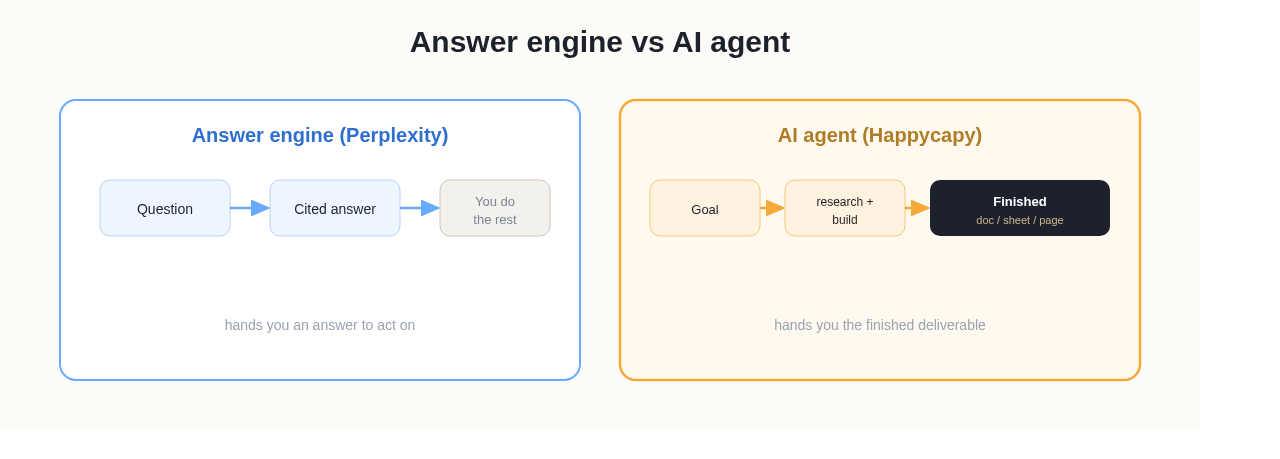 Answer engines hand you an answer; an agent hands you the finished work.
How to Choose
- You want a better cited answer → another answer engine: ChatGPT search, Gemini, or You.com. Pick by model preference.
- You want the research to become a deliverable → an AI agent like Happycapy that does the work end to end.
- You need open-source/self-hosting → orchestrate an open agentic model yourself.
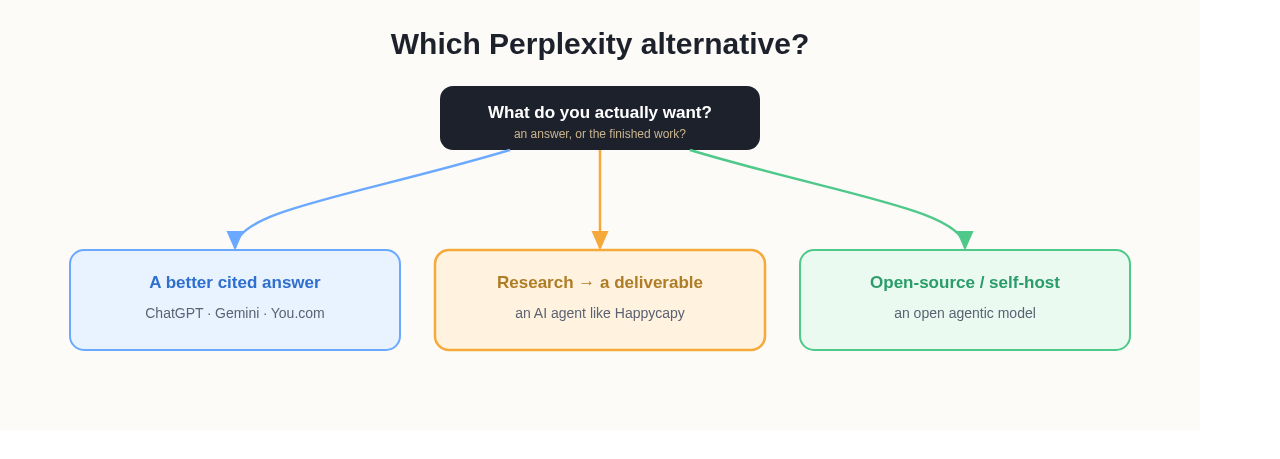 Pick by the job to be done: a better answer, or research that becomes a finished deliverable.
The honest summary: if Perplexity's answers are what you want and you're just shopping interfaces, stay in the answer-engine lane. If you keep finding that the answer is only the start (that you then have to go do something with it), you've outgrown answer engines and want an agent.
A Concrete Example: The Same Task, Two Ways
Say your job is: "Compare the top 5 project-management tools for a 20-person startup and give me a recommendation memo."
With Perplexity, you ask, and it returns a tidy, cited summary of five tools: pricing, key features, pros and cons. Genuinely useful. But you're not done: you still copy that into a doc, reformat it into a memo, add your own recommendation, and maybe build a comparison table by hand. The answer was step one of five.
With an agent like Happycapy, you hand over the whole memo as the goal. It researches the five tools, extracts pricing and features, builds the comparison table, writes the recommendation with reasoning, and delivers a formatted memo you can send, doing steps one through five. Same starting question; one hands you research, the other hands you the deliverable. That's the practical line between an answer engine and an agent, and it's why "Perplexity alternative" increasingly means "an agent," not just "another search box."
When Perplexity Is Still the Right Choice
Honesty matters here, so: if your need really is a quick, well-sourced answer ("what's the capital of X," "summarize this paper," "what did this company announce"), Perplexity (or any good answer engine) is the lighter, faster tool, and reaching for an agent would be overkill. Answer engines are excellent at the answer job. The case for switching to an agent only appears when you keep hitting the moment after the answer, when the research has to turn into something. If that moment rarely comes for you, you don't have a Perplexity problem; you have the right tool already. A good rule of thumb: if you'd be happy pasting the answer into a chat and reading it, an answer engine is fine; if you'd immediately start turning that answer into a document, a dataset, or a deck, that downstream work is the signal you want an agent instead.
Research-to-Action: The Category That's Actually New
The reason this comparison is a little unfair is that Perplexity and an agent aren't really in the same category. Answer engines made search conversational and cited, a real advance over ten blue links. Agents are making the work itself conversational: you describe an outcome and it gets produced. "Research-to-action" (where finding the information and doing something with it are one continuous flow) is the genuinely new capability, and it's why the most capable "alternative" to a research tool is increasingly not another research tool at all. If you've felt the friction of constantly ferrying answers from a search box into the documents where the work actually happens, that friction is the thing agents remove, and once you've worked that way, going back to copy-pasting out of a chat window feels like a step backward.
From Answer to Done: Try It Yourself
If that "the answer is only step one" frustration sounds familiar, that's exactly the gap Happycapy is built to close. Instead of returning a summary for you to act on, it runs an agent that researches and then produces (the brief, the comparison table, the populated spreadsheet, the draft page) in a secure browser-based sandbox, using 150+ models and real tools, with a visual desktop where you can watch and steer. It's the difference between "here's what I found" and "here's the thing you needed, done."
Start free at happycapy.ai, hand it a research task you'd normally run through Perplexity and then finish by hand, and let it do both halves. It's the fastest way to feel the difference between an answer engine and an agent.
Frequently Asked Questions
Q: What is the best Perplexity AI alternative?
It depends on what you want. For another cited answer engine, ChatGPT search, Google Gemini, or You.com are direct alternatives. If you want research that turns into a finished deliverable rather than just an answer, an AI agent like Happycapy is a more capable category.
Q: Why do people look for Perplexity alternatives?
Two main reasons: they want a different/better answer engine (model or interface preference), or they've hit Perplexity's ceiling: it answers questions but doesn't act on them, so any task where the research has to become a document, dataset, or deck needs an agent instead.
Q: What's the difference between Perplexity and an AI agent like Happycapy?
Perplexity is an answer engine: it searches and returns a cited answer. An AI agent does the research and the next steps: it builds the report, fills the spreadsheet, or drafts the page in a sandbox. Perplexity hands you an answer to act on; an agent hands you the finished work.
Q: Is there a free Perplexity alternative?
Several answer engines have free tiers (ChatGPT, Gemini), and Happycapy offers a free tier to start if you want the research-into-deliverable agent experience. Open-source agentic models are free to run (you cover compute).
Q: Which Perplexity alternative is best for deep, multi-step research?
An agent, not an answer engine. Multi-step research that follows leads and assembles a result is exactly what an AI agent like Happycapy is built for. It can search, read, extract, and produce a deliverable in one flow, rather than answering a single question at a time.
Q: Is Happycapy a search engine like Perplexity?
No, and that's the point. Perplexity is an answer engine that searches and summarizes; Happycapy is an AI agent that does the research and produces a deliverable from it. Use Perplexity for quick cited answers; use an agent when the research needs to become a document, sheet, or page.
Q: Do these alternatives cite their sources like Perplexity?
The answer engines (ChatGPT search, Gemini, You.com) cite sources much like Perplexity. An agent like Happycapy can also gather and reference sources, but its output is the finished work product rather than a standalone cited answer.
Q: What's the best free Perplexity alternative for students?
For quick cited answers, ChatGPT's and Gemini's free tiers are the closest swaps. If you need that research turned into written assignments, summaries, or study materials, Happycapy's free tier gives you the agent approach that produces the deliverable, not just the answer.