
Claude Code vs Codex CLI: Which Terminal Agent Wins in 2026?
Two terminal coding agents, same shape: Claude Code (Anthropic, closed) vs Codex CLI (OpenAI, open-source). Compare on models, open source, sandbox, and pricing, plus what OSS actually buys you.
Unlike most coding-tool comparisons, Claude Code and Codex CLI are the same shape: both are terminal-based agents you delegate coding tasks to. Neither is an editor; both read your codebase, edit files, run commands, and iterate in a loop until the job is done. So the real choice isn't interface. It's the engine and the philosophy underneath. Claude Code runs Anthropic's Claude models and is closed-source; Codex CLI runs OpenAI's models and is open-source. This guide goes deep on what that actually means for your work: the models, what open source buys you, the pricing reality, a real workflow with each, and how to get Claude Code's power without a terminal at all.
At a Glance
| Claude Code | Codex CLI | |
|---|---|---|
| Maker | Anthropic | OpenAI |
| Models | Claude | OpenAI (GPT / reasoning models) |
| Open source? | No | Yes (repo) |
| Interface | Terminal agent (+ IDE extension) | Terminal agent |
| Execution | Sandboxed | Sandboxed |
| Extensibility | MCP, hooks | MCP, fork & self-host |
| Pick it if | You prefer Claude for code | You want OpenAI models or OSS |
Claude Code in Brief
Claude Code is Anthropic's agentic coding tool for the terminal. You give it a task ("add pagination to this endpoint," "track down why this test is flaky") and it explores the codebase, makes edits, runs commands, reads the output, and keeps going until it's satisfied the task is complete. It runs Claude models, integrates with editors and MCP servers, and supports hooks for deterministic steps. It's closed-source and billed through a paid Claude plan or API usage.
Developers reach for Claude Code largely because they rate Claude's behavior on real engineering work: following instructions precisely across many files, holding a long task together without drifting, and explaining what it changed. The trade-off is that you take the tool as given. You don't see or modify how it works internally.
Codex CLI in Brief
Codex CLI is OpenAI's agentic coding tool for the terminal, and its headline difference is that it's open-source. Same core loop (delegate a task, the agent executes it in a sandbox) but it runs OpenAI's models, and you can read, fork, and self-host the harness itself. It also supports MCP and lets you switch between OpenAI models depending on the job.
Developers pick Codex CLI for the OpenAI model family and for the transparency and control of an open codebase. The trade-off is that an open tool puts more of the integration and maintenance burden on you, where a closed, managed tool hides that complexity.
Where They Actually Differ
| Dimension | Claude Code | Codex CLI |
|---|---|---|
| Vendor / models | Anthropic · Claude | OpenAI · GPT / reasoning models |
| Open source | No | Yes |
| Interface | Terminal (+ IDE extension) | Terminal |
| Sandboxed execution | Yes | Yes |
| Customize the agent itself | No (configure only) | Yes (fork the harness) |
| Billing | Paid Claude plan or API (pricing) | OpenAI plan or API |
| Best for | Teams that prefer Claude for code | Teams in the OpenAI ecosystem or wanting OSS |
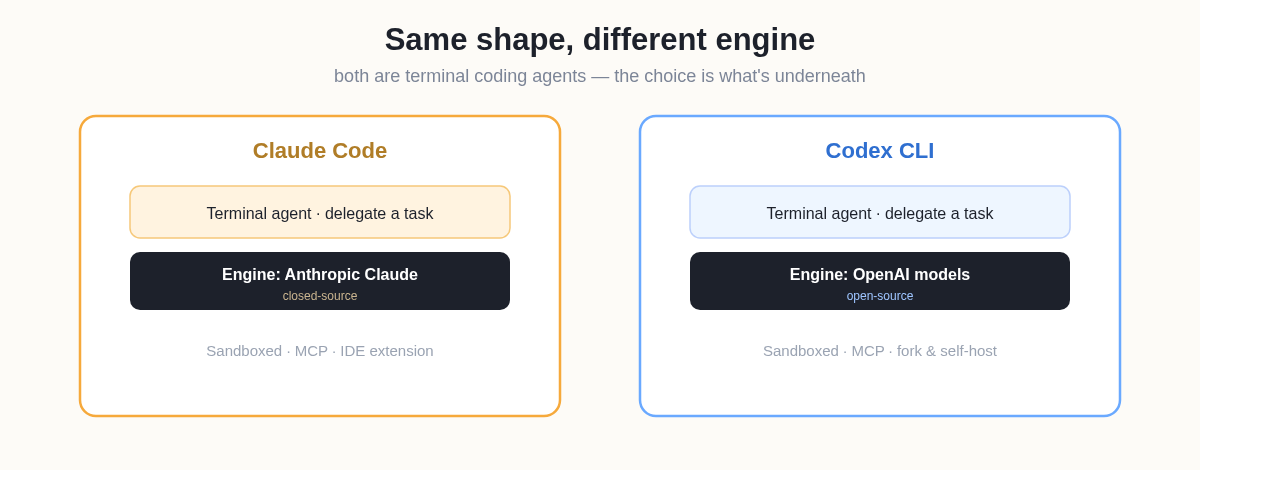 Same workflow, different engine: the choice is really about model family and open source.
What Open Source Actually Buys You
Codex CLI being open-source isn't just a license badge. It changes what you can do with the tool, and it's the clearest dividing line between the two:
- Audit the sandbox. You can read exactly how it isolates execution before trusting it with your codebase, a real factor for security-sensitive teams.
- Modify the harness. The loop, prompts, and tool wiring are yours to fork and tune. With a closed tool, you take the harness as given.
- Pin and reproduce. Lock to a specific version and reproduce builds, useful for regulated or long-lived projects.
- Run it on your terms. Self-host and keep the tooling layer inside your environment instead of depending on a vendor's update cadence.
Claude Code trades that openness for a managed, tightly-integrated experience: you can't see or change the harness, but you also don't maintain it, and you get Anthropic's polish on long multi-file refactors and a native MCP ecosystem. The real question is whether you treat the agent as infrastructure you own or a product you consume.
Models: The Part That Actually Decides It
Because the workflow is nearly identical, the model underneath is usually the deciding factor, and there's no universal winner. Claude models and OpenAI's reasoning models trade the lead on different kinds of work, and the gaps are smaller than benchmark headlines suggest. What matters is performance on your stack: your language, your frameworks, your conventions.
The only reliable test is an empirical one, and here's a protocol that takes about fifteen minutes. Pick two tasks from your own repo: one bug you've already fixed (so you know the correct answer) and one small greenfield feature. Run each through both agents and record three numbers per run: did it land a correct result, how many iterations it needed, and how often you had to step in and redirect it. Whichever agent wins on your two tasks is the one that will serve you, regardless of what any leaderboard says.
Public benchmarks like SWE-bench Verified give a rough prior on raw coding ability, but they're measured on open-source Python issues, not your codebase, your language, or your conventions. Treat them as a starting hypothesis, not a verdict. The fifteen-minute test on code you actually ship will correlate far better with day-to-day results than any published score.
The Pricing Reality
Both tools bill through their own vendor: a paid Claude plan or API for Claude Code, an OpenAI plan or API for Codex CLI, and both share one important trait: agentic coding is token-heavy. A single task can read large portions of a codebase, run tools, and iterate many times, consuming far more tokens than a one-off chat. That makes a flat plan more predictable for steady daily use and metered API billing more economical for occasional or bursty use. Whichever you pick, watch tokens-per-task, not just the monthly fee. That's the number that actually moves your bill.
A Real Workflow With Each
Picture the same task, "upgrade this service to the new auth library and fix what breaks", run two ways:
- Claude Code: you run it in your project directory, describe the goal, and it works through the migration file by file, runs the test suite, sees three failures, fixes them, and reports a summary of every change. You review the diff and commit. The appeal is the hands-off polish.
- Codex CLI: the same flow, but because the harness is open, your platform team has pinned a specific version, tweaked the system prompt to enforce your house style, and confirmed how it sandboxes execution before it ever touches the repo. The appeal is the control.
Concretely, the loop looks the same from the keyboard: you run claude (or codex) in the project directory, type the goal, and watch a running log of the files it opens, the edits it proposes, and the test commands it runs, approving or redirecting as it goes, then reviewing the final diff before you commit.
Played out, that auth migration with Claude Code might go like this: it opens the files importing the old library, rewrites the imports and the token-refresh calls, runs npm test, sees three specs fail on an expired-token edge case, traces it to a changed return shape in the new library, patches the handler, re-runs the suite to green, and hands you a summary of the eight files it touched. You skim the diff and commit. With Codex CLI the same sequence runs on OpenAI's model and on an open harness you may have pre-configured. The steps are identical; what differs is whose engine reasoned through that edge case, and whether you tuned the harness that drove it. Same outcome shape; the difference is how much trust sits in the tool versus in your own configuration of it.
Security and Sandboxing: Trust vs Verify
Both agents can run commands, which means both can, in principle, do damage: delete the wrong files, leak a secret, or be hijacked by a prompt-injection attack hidden in a file or web page they read. So both run execution in a sandbox, and for either tool the rule is the same: keep it isolated from anything you can't afford to lose, and grant the least access it needs.
Where they diverge is how you gain confidence in that sandbox. With Codex CLI you can verify. Read the open-source code that governs isolation and confirm exactly what it can and can't touch. With Claude Code you trust. Anthropic designs and maintains the sandboxing, and you rely on the vendor rather than reading the implementation. Neither model is automatically safer; it's the classic trust-vs-verify trade-off. Security-sensitive teams that need to audit the execution path will value Codex's openness; teams that would rather not own that responsibility will prefer Claude Code's managed approach. Either way, treat everything the agent reads from the outside world as untrusted input, and never point a capable agent at production credentials it doesn't strictly need.
Using Both Together
Because the workflow is identical, switching costs are near zero, and a practical pattern emerges: reach for Codex CLI on open-source projects where auditability and a forkable harness matter, and Claude Code on enterprise repos where you want Anthropic's MCP integrations and don't need to own the tooling. Some developers also keep both simply to pit the two model families against each other on a hard bug and take whichever solution lands. The only real friction is managing two billing relationships, not two mental models.
Run the Head-to-Head in One Tab: No Two Installs
This comparison keeps landing on the same advice: test both on your own code. The friction is that doing it properly means installing two CLIs, creating two vendor accounts, and reconciling two billing setups, just to run one task twice.
Happycapy collapses that into a browser tab. It runs Claude Code and 150+ models, including OpenAI's, in a managed cloud sandbox, so you can put the same task to Claude and to an OpenAI model side by side and compare correctness, iterations, and output quality without touching a terminal or wiring up either vendor. No install, no API keys, no setup; you watch each run on a visual desktop and keep whichever result wins. It's the fastest way to actually run the fifteen-minute test this post recommends, and the only practical way to put either workflow in front of teammates who don't live in a shell.
Start free at happycapy.ai and run your first head-to-head in minutes. (Comparing Claude Code against an editor like Cursor rather than another terminal agent? That's a different question. See Claude Code vs Cursor.)
Frequently Asked Questions
Q: What's the difference between Claude Code and Codex CLI?
Both are terminal-based AI coding agents with nearly the same workflow. The differences are underneath: Claude Code is Anthropic's, runs Claude models, and is closed-source; Codex CLI is OpenAI's, runs OpenAI models, and is open-source. Choose by model preference and whether open source matters.
Q: Can I self-host or modify the agent itself?
With Codex CLI, yes. It's open-source, so you can self-host it and modify the harness (the loop, prompts, and tool wiring), or audit how it sandboxes execution. Claude Code is closed-source: you configure and use it, but you can't change or self-host the agent itself.
Q: Which is better for coding, Claude Code or Codex CLI?
It depends on which model family performs better on your codebase. There's no universal winner. Because the workflows match, the most reliable test is running the same real task through both on your own repo and comparing the results.
Q: Do Claude Code and Codex CLI cost the same?
Not necessarily. They bill through their respective vendors (a paid Claude plan or API for Claude Code; an OpenAI plan or API for Codex). Check each vendor's current pricing, and watch token usage, since agentic coding is token-heavy on either.
Q: How can I compare Claude Code and Codex outputs without installing both?
Run them through a managed platform like Happycapy that hosts Claude and OpenAI models in one browser tab. You put the same task to each and compare results directly: no two CLI installs, no two vendor accounts, no terminal setup. It's also the easiest way to let non-developers use either workflow.
Q: Is Codex CLI really open source?
Yes, its code is publicly available to read, fork, and self-host. That's the main structural difference from Claude Code, which is closed-source.
Q: Does either one work inside my IDE?
Claude Code offers an IDE extension alongside the terminal, so it can surface inside your editor; Codex CLI is terminal-first. If having the agent in your editor matters, Claude Code has the edge today, though both are designed primarily around the delegate-a-task terminal workflow rather than inline, keystroke-level editing (that's more the domain of an AI editor like Cursor).