Grok 4.20: xAI's Fast, Tool-Calling Model, Explained
Grok 4.20 is xAI's fast, agentic model with a 1M-token context and a low hallucination rate. The verified specs, pricing, what it's good at, and how to use it with no API key.
Grok 4.20 is xAI's high-performance language model built for speed and agentic tool calling, with a 1-million-token context window and what xAI calls the lowest hallucination rate on the market. If you've seen the name and want to know what it actually is, what it's good at, what it costs, and the fastest way to try it without touching an API, this guide lays out the verified specs and shows you how to put it to work in a browser.
The Short Answer
Grok 4.20 is a model from xAI positioned around three things: fast responses, strong agentic tool calling, and accuracy (xAI describes it as having "the lowest hallucination rate on the market with strict prompt adherence"). It takes text and image input, produces text output, supports function calling, structured outputs, and reasoning, and carries a very large 1,000,000-token context window. In plain terms: it's tuned to be a reliable, fast engine for agents that call tools and follow instructions precisely.
Grok 4.20 Specs at a Glance
| Spec | Grok 4.20 |
|---|---|
| Maker | xAI |
| Context window | 1,000,000 tokens |
| Input | Text + image |
| Output | Text |
| Function calling | Yes |
| Structured outputs | Yes |
| Reasoning | Yes |
| Positioning | Industry-leading speed; lowest hallucination rate (per xAI) |
| Pricing (per 1M tokens) | $1.25 input · $0.20 cached input · $2.50 output |
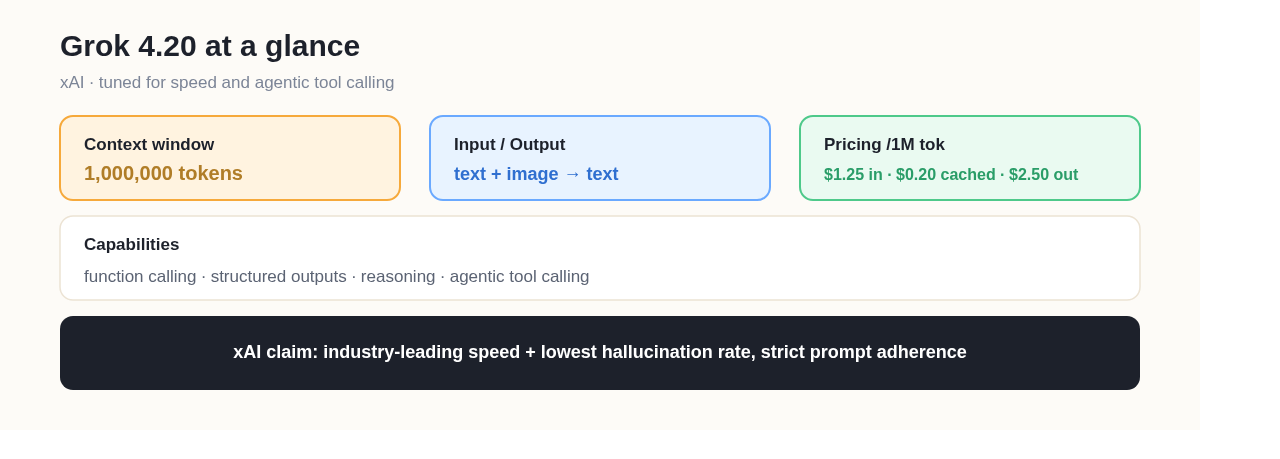 Grok 4.20 at a glance: a fast, large-context model tuned for agentic tool calling.
What Grok 4.20 Is Good At
The spec sheet points to a clear profile. Grok 4.20 is built to be an agent's engine, and three traits stand out:
- Agentic tool calling. Strong, reliable function calling is what lets a model act: choose a tool, call it with the right arguments, use the result. xAI leads its description of Grok 4.20 with this, which signals it's tuned for tool-using agents, not just chat.
- Speed. "Industry-leading speed" matters a lot in agent loops, where a model may be called many times in sequence; faster per-step responses compound into a much snappier agent.
- Accuracy and prompt adherence. A low hallucination rate and "strict prompt adherence" are exactly the traits that make an agent trustworthy across a long, multi-step task. A model that drifts or invents facts is a liability when it's acting, not just answering.
Add the 1M-token context window, and Grok 4.20 can hold a lot of material in view at once (a large codebase, a long document set, or an extended agent history) without dropping the thread.
What Grok 4.20 Costs
Pricing is usage-based, per million tokens (per xAI's model docs): $1.25 for input, $0.20 for cached input, and $2.50 for output. The cached-input rate is worth noting. If your workload re-sends a lot of the same context (common in agent loops and long sessions), caching can cut the input cost substantially. As always with agentic use, the figure that actually drives your bill is tokens-per-task, since a tool-using agent can consume far more than a single chat exchange.
How Grok 4.20 Compares
You don't pick a model in isolation. Grok 4.20's case is speed + large context + reliable tool calling, which puts it in the conversation with other frontier models tuned for agentic work:
| If you want… | Consider |
|---|---|
| Fast, low-hallucination, big-context tool calling | Grok 4.20 |
| A managed coding-agent ecosystem | Claude (e.g. via Claude Code) |
| Open-weight, agentic, self-hostable | Kimi K2.6 or MiniMax M2.7 |
There's no universal winner. Model leadership shifts constantly, and the honest test is running your own task through a few. Grok 4.20's distinct pitch is the combination of speed and a very low hallucination rate, which is especially appealing when an agent's mistakes are expensive.
Why Speed Compounds in an Agent Loop
Speed sounds like a nice-to-have until you watch an agent work. A chatbot calls the model once per message, so a half-second difference barely registers. An agent calls the model repeatedly (reason, act, observe, repeat) often dozens of times for a single task. At ten or twenty model calls per task, a model that's meaningfully faster per call turns a two-minute agent run into a forty-second one. That's the difference between an agent you wait on and one that feels responsive. xAI leading Grok 4.20's pitch with "industry-leading speed" isn't a vanity metric; for agentic use it's one of the traits you feel most directly, because the loop multiplies it.
The 1M-Token Context Window in Practice
A 1,000,000-token context window is large enough to change how you use the model. You can drop an entire mid-size codebase, a long set of documents, or a deep agent history into context and have it all available at once: no aggressive chunking, no constant re-retrieval. For agentic work, that means the model can keep the full task state in view across a long run rather than forgetting earlier steps. The caveat (covered below) is that a big window isn't a license to fill it: every token still costs money and competes for the model's attention, so context engineering, putting the right things in the window, matters even when the window is huge. But having the headroom removes a whole class of "it lost track of what it was doing" failures.
A Realistic Grok 4.20 Workflow
Picture handing it: "Go through this 600-page API spec and our codebase, find every endpoint we call that's now deprecated, and list the replacements." Grok 4.20's profile fits the job: the 1M-token window lets it hold large chunks of both the spec and the code at once; its tool calling lets it search files and check references; its low-hallucination, strict-adherence tuning means the list it returns is more likely to be actually deprecated endpoints, not plausible-sounding inventions, which matters enormously when the output is a to-do list someone will act on. Same model, run inside an agent loop with file tools, turns a tedious day of grepping into a single delegated task.
Caveats Worth Knowing
A balanced view before you commit:
- Vendor positioning isn't an independent benchmark. "Lowest hallucination rate on the market" is xAI's claim; treat it as a signal of what the model is tuned for and verify on your own prompts.
- Big context isn't free. A 1M-token window is powerful, but stuffing it full costs tokens and can still suffer from attention limits. Good context engineering still matters.
- Capability needs a harness. Grok 4.20's tool-calling strength only shows up when it's wrapped in an agent loop with actual tools and a sandbox. The raw model is an engine; it needs a chassis to drive.
How to Use Grok 4.20 Without an API Key
You can call Grok 4.20 directly through xAI's API (with model identifiers like grok-4.20-reasoning), which is the right path if you're a developer wiring it into your own stack. But if you just want to use it (no API keys, no billing setup, no code), the fastest way is Happycapy. Grok 4.20 is one of the 150+ models available in Happycapy, an agent-native computer that runs in your browser: you pick Grok 4.20, describe a task, and it executes inside a secure cloud sandbox with the tools and agent loop already wired up.
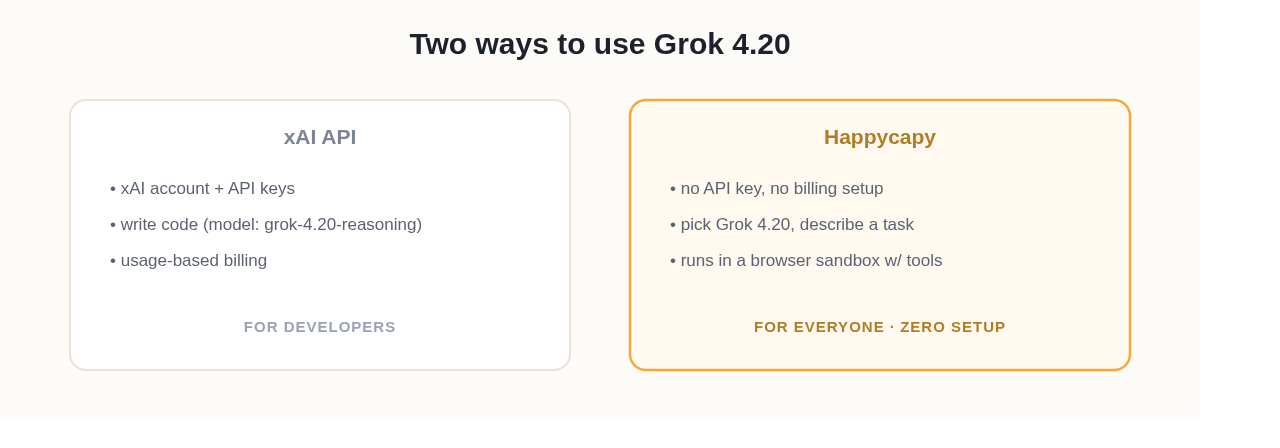 Two routes to Grok 4.20: the raw API, or a no-setup browser platform.
This pairing plays directly to Grok 4.20's strengths. Its headline is agentic tool calling and speed, and an agent platform is exactly where those shine, because the model has real tools to call and a loop to run them in. You also get to exploit its low-hallucination, strict-adherence profile on actual multi-step work, watch it on a visual desktop, and step in when you want. And because Happycapy hosts many models, you can run the same task on Grok 4.20 and on Claude or an open model to see which you prefer, no extra accounts.
Start free at happycapy.ai, choose Grok 4.20, and give it a real task. It's the quickest way to judge the speed and accuracy for yourself, with zero setup.
Getting the Most Out of Grok 4.20
A few practical notes for using it well:
- Lean on cached input for loops. If your agent re-sends a stable system prompt or document set each step, the discounted cached-input rate ($0.20 vs $1.25 per 1M tokens) makes long sessions much cheaper. Structure your context so the stable part is cacheable.
- Use the big window deliberately. A 1M-token window invites dumping everything in; resist it. Put the genuinely relevant material in view and summarize the rest, so you pay only for tokens that earn their place.
- Point it at tool-heavy work. Grok 4.20's strengths (fast, reliable function calling and strict adherence) pay off most on multi-step, tool-using tasks, not single questions. Give it jobs where it has tools to call.
- Verify the accuracy claim yourself. "Lowest hallucination rate" is xAI's positioning; if accuracy is mission-critical, run your own spot-checks before trusting it to act unattended.
- Pin an identifier for stability. Target a specific model identifier when you need consistent behavior over time, rather than relying on a floating alias that may shift as the model is updated, the same reproducibility discipline you'd apply to any production dependency.
Frequently Asked Questions
Q: What is Grok 4.20?
It's xAI's high-performance language model tuned for speed and agentic tool calling, with a 1,000,000-token context window, text-and-image input, function calling, structured outputs, and reasoning. xAI positions it as having the lowest hallucination rate on the market with strict prompt adherence.
Q: What is Grok 4.20's context window?
1,000,000 tokens: large enough to hold a sizable codebase, a long document set, or an extended agent history in view at once.
Q: How much does Grok 4.20 cost?
Per million tokens: $1.25 input, $0.20 cached input, and $2.50 output. The discounted cached-input rate helps when your workload re-sends a lot of the same context, as agent loops often do.
Q: Is Grok 4.20 good for AI agents?
Yes, it's pitched at exactly that. Strong function calling, speed, and a low hallucination rate are the traits that make a model a reliable engine for tool-using, multi-step agents.
Q: How can I use Grok 4.20 without coding?
Run it through a managed platform like Happycapy, where Grok 4.20 is one of 150+ models available in the browser. You pick it and give it a task: no API key, no billing tier, no scripts.
Q: What model identifier and regions does Grok 4.20 use?
Per xAI's model documentation, the underlying model identifier is grok-4.20-0309-reasoning, with friendlier aliases such as grok-4.20 and grok-4.20-reasoning. Via the API it's offered across multiple regions, including us-east-1, eu-west-1, and us-west-2.
Q: Is Grok 4.20 multimodal?
It accepts text and image input and produces text output, so you can give it images to analyze, but it generates text, not images. For image generation you'd reach for a dedicated image model.
Q: What does the cached-input price mean in practice?
When you re-send the same context (a system prompt, a long document) across calls, that repeated input is billed at the lower cached rate: $0.20 per 1M tokens versus $1.25 for fresh input. In agent loops that reuse context heavily, this can cut input costs substantially.
Q: Grok 4.20 vs an open model like Kimi K2.6, which should I use?
Grok 4.20 is a fast, low-hallucination, closed model with a huge context window; Kimi K2.6 and MiniMax M2.7 are open-weight, self-hostable agentic models. Choose by whether you value hosted speed/accuracy or open-source control, and test the same task through each, which is easy on a platform that hosts several.