Kimi K2.6 Explained: Moonshot's Open-Source Coding & Agent Model
Kimi K2.6 is Moonshot AI's open-weight model for coding and autonomous agents. What it is, what it's good at, how it compares, and the fastest way to run it in your browser, no API.
Search "Kimi K2.6" and you'll find a model making a pointed bet: that an open-source model can compete at the frontier of coding and autonomous agents. It's the latest release in Moonshot AI's K2 line, weights and code published openly, tuned for state-of-the-art coding, long-horizon execution, and "agent swarm" work. This guide covers what it actually is, whether it's any good, and the fastest way to try it without wrestling an API.
What Is Kimi K2.6?
Kimi K2.6 is the latest in Moonshot AI's K2 model line, an open-weight model, meaning Moonshot publishes the weights and code (on Hugging Face and GitHub) so anyone can download, inspect, self-host, or build on it. That openness is a big part of why it gets attention: it puts frontier-class coding and agent capability in a model you can actually own, rather than only rent through a closed API.
Moonshot describes K2.6 as optimized for three things in particular:
- Coding: generating, editing, and debugging code, with a focus on real software-engineering tasks rather than toy snippets.
- Long-horizon execution: staying coherent across long, multi-step tasks instead of losing the thread after a few turns.
- Agentic / "agent swarm" work: operating as an autonomous agent that uses tools, and coordinating multiple agents on a larger job.
It also extends into visual-agent and full-stack/front-end development territory. In short: Kimi K2.6 is pitched less as a chatbot and more as an engine for agents that do work, which is exactly why it matters to anyone building or using AI agents.
Why Kimi K2.6 Is Getting Attention
Three things make K2.6 notable beyond the usual model-release noise:
- It's open source at the frontier. Most models competing for "best at coding" are closed. An open-weight model in that tier is rare, and it means no vendor lock-in on the model layer. You can run it where you want.
- It's agent-first. The capabilities Moonshot leads with (long-horizon execution, tool use, agent swarms) are precisely what you need for autonomous coding agents, not just Q&A.
- It's accessible. It's free to use through Moonshot's own surfaces, with paid plans available, and because the weights are open it's also showing up across third-party platforms.
What Kimi K2.6 Is Good At
The clearest way to understand a model is by what it's built to do. Moonshot benchmarks K2.6 across coding and agentic categories, including suites like Terminal-Bench 2.0, SWE-Bench Pro, SWE-Multilingual, and general-agent tests such as Humanity's Last Exam, BrowseComp, and OSWorld-Verified, plus visual benchmarks like MathVision. (Vendor benchmark selections always reflect a model's strengths, so treat them as a map of what it's tuned for rather than an objective ranking. The real test is your own task.)
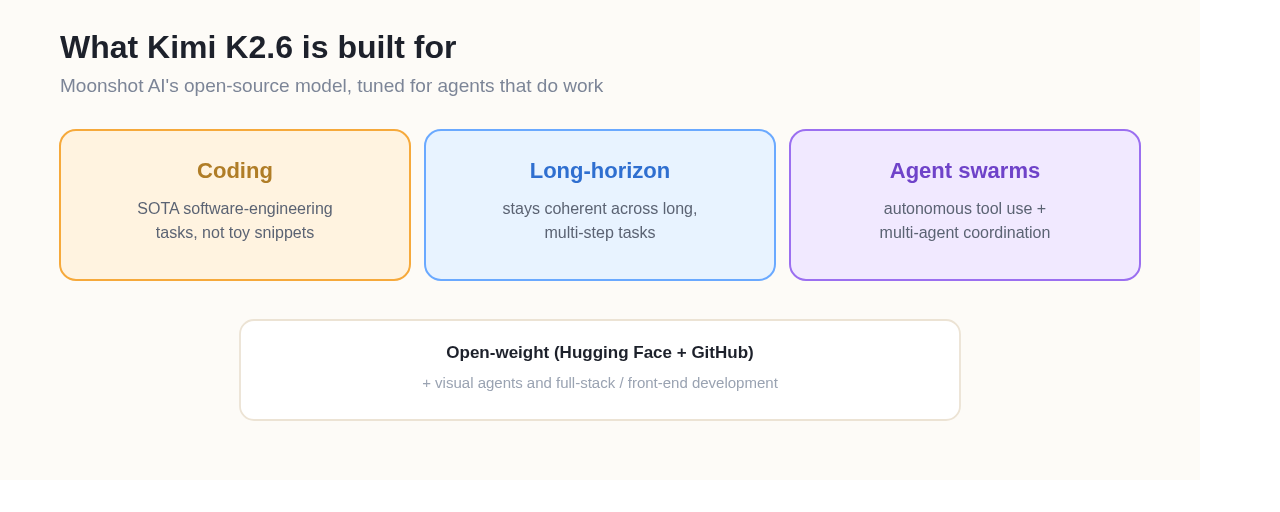 What Moonshot tunes Kimi K2.6 for: coding, long-horizon execution, and agentic work.
In practice, that profile makes K2.6 a strong candidate when your task is "do this multi-step coding job," not just "answer this question." Fixing a bug across several files, scaffolding a feature, or running a long research-and-build loop are the kinds of work it's designed for.
How Kimi K2.6 Fits Among Other Models
You don't choose a model in a vacuum, so here's the honest positioning:
| If you want… | Consider |
|---|---|
| Open weights + strong coding/agent focus | Kimi K2.6 |
| A tightly-managed, closed coding agent | Claude (e.g. via Claude Code) |
| An open-source agentic-workflow model | MiniMax M2.7 |
| Maximum raw general reasoning | A frontier closed model (GPT/Claude/Gemini tier) |
The point isn't that one wins. It's that Kimi K2.6 occupies a specific, valuable slot: open-weight, coding- and agent-optimized. If that matches your need, it's one of the most interesting options available; if you need something else, the table points you elsewhere.
Open Weights: What That Actually Buys You
"Open source" is the word everyone uses, but with a model it has specific, practical consequences, and they're the reason K2.6's openness matters beyond ideology:
- Self-host anywhere. You can run K2.6 on your own infrastructure (a cloud GPU, an on-prem cluster, even air-gapped) instead of depending on one vendor's API uptime, rate limits, or pricing changes.
- Inspect and trust. Researchers and security teams can examine the model rather than treat it as a black box, which matters for regulated or sensitive deployments.
- Fine-tune and adapt. Open weights can be further trained on your own data or domain, something closed APIs rarely allow.
- No lock-in at the model layer. If a better open model arrives, you can switch without re-architecting around a proprietary endpoint.
The trade-off, of course, is that self-hosting means owning the GPUs, the serving stack, and the ops. That's why most people who want K2.6's capabilities without its operational burden reach for a hosted option (covered below) rather than running it themselves.
Where Kimi K2.6 Sits in the K2 Line
K2.6 didn't appear from nowhere. It's the current step in Moonshot's K2 family, which has evolved through a series of releases (the line includes earlier K2 models and a reasoning-focused "K2 Thinking" variant, among others). Each iteration has pushed harder on the same north star: coding ability and autonomous, long-horizon agent work. K2.6 is the latest expression of that trajectory, which is why its headline capabilities cluster around software engineering and agent swarms rather than, say, creative writing. If you've used an earlier K2 model, K2.6 is the continuation of that coding-and-agents focus, not a change of direction. The practical takeaway: because every step in the line has been released as open weights, the family has effectively given the open-source community a steadily-improving coding-and-agent model to build on, and K2.6 is the current high-water mark of that effort.
How to Use Kimi K2.6
There are three broad ways to get hands on it:
- Moonshot's own surfaces: the Kimi website, app, API, and Kimi Code. Best if you want it straight from the source and are comfortable with their platform and (for the API) wiring up keys.
- Self-host the open weights: download from Hugging Face/GitHub and run it on your own infrastructure. Maximum control, but you own the GPUs, setup, and maintenance.
- A managed multi-model platform: run it through a service that already hosts many models, so there's nothing to install or key-manage. This is the lowest-friction path, and it's where Happycapy comes in.
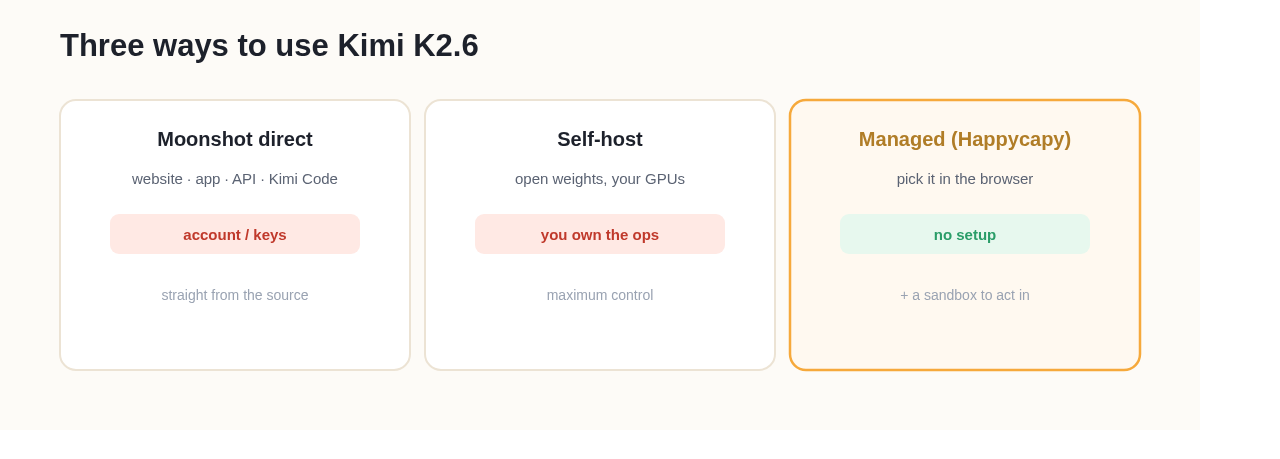 Three routes to Kimi K2.6: only the managed path needs no setup at all.
Try Kimi K2.6 Without Building the Harness Around It
Here's the catch with any agentic model: its headline strengths (long-horizon execution, tool use, agent swarms) only show up when it has somewhere to act. A raw API call to K2.6 hands you text back; it can't open your files, run your tests, or browse the web, because none of that machinery ships with the model. You'd have to build the harness yourself.
Happycapy is that harness, ready-made. It runs Kimi K2.6 in your browser with a live filesystem, terminal, and sandbox already wired up, so you can hand K2.6 a concrete job like "scaffold this feature branch and get the tests passing" and watch it actually carry it out on a visual desktop, stepping in whenever you want. No API keys, no GPUs, no environment to configure. And since Happycapy hosts 150+ models, you can run the same task on K2.6 and on a Claude or OpenAI model and keep whichever result is better, without opening three separate accounts.
Start free at happycapy.ai, choose Kimi K2.6, and give it a real coding task, the quickest way to see whether the model lives up to the hype, with the agent environment already built for you.
The Honest Caveats
No model is the right answer for everything, and a balanced view of K2.6 helps you choose well:
- Vendor benchmarks aren't independent. The benchmark categories Moonshot leads with show what K2.6 is tuned for, but they're chosen by the maker. Treat them as direction, not a neutral ranking, and test on your own tasks before committing.
- "Open weights" isn't "free at scale." You can download K2.6 for nothing, but running a frontier-size model yourself means real GPU cost and serving complexity. Free-to-download and cheap-to-operate are different things.
- It's specialized. K2.6 is tuned for coding and agentic work. For pure creative writing, certain non-English niches, or tasks far from its focus, a different model may serve you better.
- Capability ≠ usability. Its agent strengths only show up when it has tools, a sandbox, and a task loop around it. The raw model on its own won't autonomously do things. It needs a harness (which is exactly the gap a managed platform fills).
- The space moves fast. Model leadership changes month to month. K2.6 is a strong current option, but "best open coding model" is a moving title, which is another argument for using it somewhere you can swap models easily.
None of these are reasons to avoid K2.6. They're reasons to go in with clear expectations and to try it on your real work rather than trusting a leaderboard.
Who Should Use Kimi K2.6?
- Developers building agents who want an open-weight model tuned for coding and tool use.
- Teams that value open source: for auditability, self-hosting, or avoiding model lock-in.
- Anyone curious about the latest coding model who wants to compare it against the closed frontier on their own tasks.
If you specifically need the absolute top of a particular closed-model leaderboard, or a deeply managed enterprise stack, weigh K2.6 against those, but for open, agent-focused coding, it's a leading option.
Frequently Asked Questions
Q: Is Kimi K2.6 open source?
Yes, Moonshot AI publishes Kimi K2.6's weights and code openly (on Hugging Face and GitHub), so you can download, inspect, self-host, or build on it. That open-weight status is one of its main draws.
Q: What is Kimi K2.6 best at?
Coding and agentic work. Moonshot tunes it for software-engineering tasks, long-horizon (multi-step) execution, and autonomous agent / "agent swarm" use, with additional visual-agent and full-stack development capabilities.
Q: Who makes Kimi K2.6?
Moonshot AI, the company behind the Kimi model family. K2.6 is the latest model in its K2 line.
Q: How can I use Kimi K2.6 without an API key or setup?
Use a managed agent platform like Happycapy: it runs K2.6 with a sandbox, filesystem, and tools already in place, so you pick the model in your browser and hand it a task. No keys or GPUs, and, crucially, the environment an agent needs to actually act is already there, which a bare API call doesn't give you.
Q: Is Kimi K2.6 free?
It's free to use through Moonshot's own surfaces, with paid plans available for heavier use. Self-hosting the open weights is free of license cost but you pay for the compute. Managed platforms bundle access into their own plans.
Q: Is Kimi K2.6 good for agentic coding specifically?
That's exactly its target. Its emphasis on long-horizon execution and tool-using agents makes it well-suited to autonomous, multi-step coding tasks, the kind where an agent reads a codebase, makes changes, runs tests, and iterates.
Q: Can I fine-tune Kimi K2.6 on my own data?
Because the weights are open, yes. You can fine-tune or adapt K2.6 to your own domain if you self-host, which closed APIs generally don't allow. You'll need the compute and ML tooling, but the option exists, unlike with proprietary models.
Q: What's the difference between Kimi K2.6 and Kimi K2 Thinking?
They're members of the same K2 family. "K2 Thinking" is a reasoning-focused variant, while K2.6 is the latest mainline release continuing the family's coding-and-agents focus. Want extended step-by-step reasoning? Look at the Thinking variant. Want the current coding/agent flagship? That's K2.6.
How Kimi K2.6 Compares to Other Open Models
The open-weight frontier is crowded in 2026. Here is honest positioning against the models that come up most often alongside K2.6.
Kimi K2.6 vs DeepSeek
DeepSeek's latest open models are K2.6's closest open-weight rivals on coding, and in practice the two trade blows depending on the task. Moonshot AI positions the Kimi K2 family as MoE models that are "exceptional on agentic intelligence," and K2.6 leans into that. It is built for multi-step, tool-using work rather than single-shot answers. If your workload is long-horizon agentic coding, K2.6 is designed for it; for other trade-offs (raw context length, cost per token) a DeepSeek model may fit better. Benchmark leadership shifts release to release, so test both on your own task rather than trusting a leaderboard snapshot.
Kimi K2.6 vs MiniMax M2.7
MiniMax M2.7 is another strong open agentic model, generally positioned as lighter and cheaper per token. K2.6 is the pick when the task needs deeper multi-step autonomy; M2.7 is worth a look when cost is the primary constraint and the task is simpler.
Kimi K2.6 vs closed models (Grok, Claude)
Closed-API models like Grok 4.20 and Claude Haiku 4.5 offer vendor-backed SLAs and, in some cases, top-of-leaderboard general reasoning, but none let you download the weights, self-host, or fine-tune. If open ownership of the model layer matters (regulated industries, air-gapped infrastructure, domain fine-tuning), K2.6 is in a different category from any closed API.
When to pick Kimi K2.6
- The task is a real multi-step coding job, not a single question and answer.
- You want open weights, for self-hosting, auditability, or fine-tuning on your own data.
- You want to benchmark an open model against a closed frontier model on the same task, side by side, which you can do on Happycapy without opening multiple accounts.
When to look elsewhere
If you need the largest possible context window, or the absolute ceiling of general reasoning rather than coding, a different model may edge it out. If cost-per-token is the only driver and the task is simple, a smaller open model will serve fine.
The bottom line: K2.6 occupies a specific, well-defined slot (an open-weight, MoE, agent-focused model) and it is one of the strongest options in that slot available today.
Frequently Asked Questions
Q: Is Kimi K2.6 really open source?
Yes. Kimi K2.6 is published by Moonshot AI as an open-weight model. The weights are available on Hugging Face, and it is part of Moonshot's Kimi K2 family of Mixture-of-Experts (MoE) models with roughly a trillion total parameters. That means you can self-host it, audit it, or fine-tune it on your own data, subject to its license, something no closed API model allows.
Q: How is Kimi K2.6 efficient despite being so large?
It uses a Mixture-of-Experts (MoE) architecture: although the model has on the order of a trillion total parameters, only a fraction of them are activated for any given token. That design is what lets a model of this scale run at competitive API prices instead of requiring frontier-model compute for every single request.
Q: Can I use Kimi K2.6 without self-hosting it?
Yes. Beyond Moonshot AI's own surfaces, Kimi K2.6 is available on Happycapy, one of 150+ models on the platform. You pick it from the model list in your browser, and Happycapy supplies the sandbox, filesystem, and tool loop that K2.6's agentic capabilities need. No GPU provisioning, no API-key management, and no serving stack to maintain.