
Agentic AI vs Generative AI: The Leap from Answering to Acting
Generative AI creates content on request; agentic AI takes autonomous action toward a goal. A clear breakdown (respond vs act) with a worked example, comparison tables, and how they combine.
The difference in one line: generative AI creates content when you ask it to, while agentic AI takes action on its own to reach a goal. A generative model writes the email; an agentic system decides the email is needed, writes it, sends it, and follows up. Generative AI responds; agentic AI acts. They aren't rivals. Agentic AI is almost always built on top of generative models, but confusing the two leads to picking the wrong tool, over-trusting a chatbot, or under-using what modern AI can actually do. This guide draws the line clearly, with concrete examples, common misconceptions, a way to tell which one any product is really using, and where each fits.
The Short Answer
| Generative AI | Agentic AI | |
|---|---|---|
| Core job | Produce content from a prompt | Pursue a goal through actions |
| Mode | Responds when asked | Acts autonomously, multi-step |
| Output | Text, code, images, audio | Completed tasks and outcomes |
| Needs a human to | Prompt it each time | Set the goal, then supervise |
| Example | "Write a product description" | "Launch and monitor this product page" |
What Is Generative AI?
Generative AI is a class of models that produce new content (text, code, images, audio) in response to a prompt. A large language model answering a question, a diffusion model rendering an image, a coding assistant completing a function: all generative. Under the hood, these models learn statistical patterns from enormous training sets and use them to predict the most plausible next token, pixel, or sample given your input.
The defining trait is creation on request. Generative AI is reactive by design: you prompt, it generates, and then it stops and waits. It has no goals of its own, no memory of what it was doing five minutes ago unless you supply it, and no ability to take an action in the world. Ask it to "book a flight" and it will write you a beautiful description of how to book a flight. It will not actually book one. That ceiling isn't a flaw; it's the category. Generative AI is a phenomenally capable content engine, and on its own, that's exactly what it is.
What Is Agentic AI?
Agentic AI is the use of AI to act autonomously toward a goal, perceiving a situation, deciding what to do, taking actions with tools, observing the results, and repeating until the objective is met. It typically uses a generative model as its reasoning core but wraps it in the machinery needed to do things rather than just describe them. The defining trait is autonomous, multi-step action.
Most agentic systems are assembled from five parts:
- A goal: the objective the system works toward, set by a human.
- A loop: the reason → act → observe cycle that drives it forward until done.
- Tools: the actions it can take: run a command, call an API, edit a file, search the web.
- Memory: state that persists across steps so it doesn't lose the thread.
- Guardrails: sandboxes, approvals, and limits, because a system that acts can cause real consequences.
Give the same "book a flight" instruction to an agentic system and it will search options, compare prices, apply your preferences, and complete the booking, pausing only if it hits something that needs your approval.
The Core Difference: Respond vs Act
The single distinction that matters is autonomy. Generative AI waits for instructions and returns content; agentic AI is given an objective and works out the steps to achieve it without being prompted at each one.
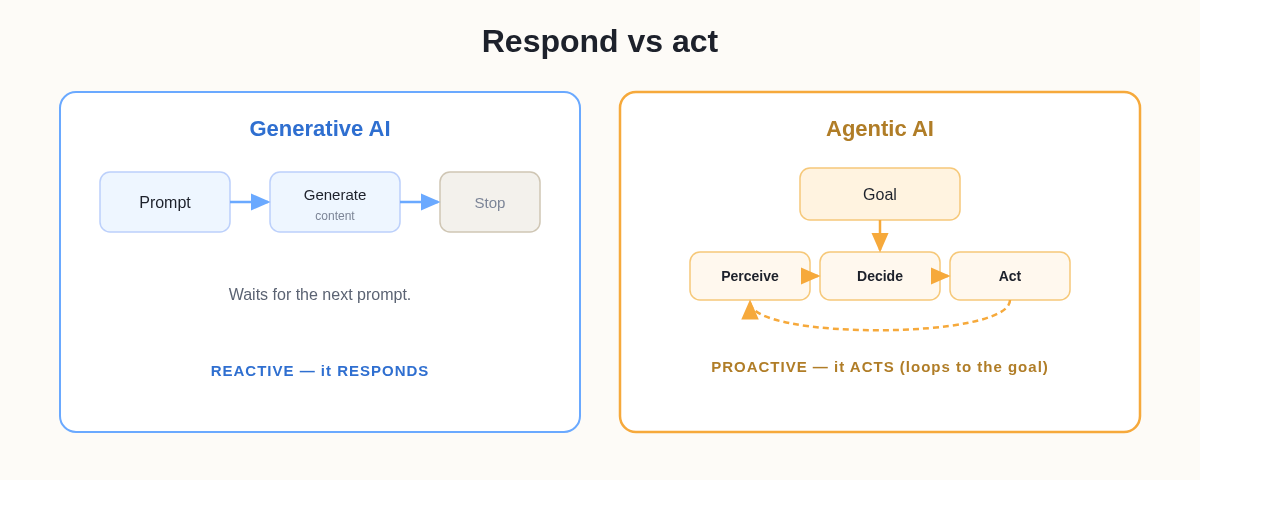 Generative AI returns content and stops; agentic AI loops through actions until the goal is met.
A useful test: if removing the human means nothing else happens, it's generative. If removing the human means the system keeps working toward the goal, it's agentic.
Make it concrete with one task: handle a customer refund request. Generative AI drafts the reply when you paste in the customer's email; you still decide, send, and follow up. Agentic AI reads the incoming ticket on its own, looks up the order in your system, checks it against the refund policy, issues the refund through the payment tool, replies to the customer, and closes the ticket, pausing only if something needs approval. Same underlying language model in both; the difference is entirely the goal, tools, and loop wrapped around it. (Industry framings from IBM and Red Hat draw the same line: content generation vs autonomous action.)
Side by Side
| Dimension | Generative AI | Agentic AI |
|---|---|---|
| Initiative | Reactive (prompt-driven) | Proactive (goal-driven) |
| Steps | Usually one shot | Many, in a loop |
| Tools/actions | None by default | Calls tools, runs code, uses apps |
| Memory | Per conversation | Often persistent across steps |
| Error handling | You spot and re-prompt | It observes failures and retries |
| Risk profile | Bad text | Bad actions (needs guardrails) |
| Human role | Operator (prompts each step) | Supervisor (sets goal, reviews) |
| Best for | Drafting, summarizing, ideating | Executing multi-step work end to end |
How They Work Together
Agentic AI is usually built on top of generative AI, not instead of it. The generative model is the engine, it supplies the reasoning and language ability, and the agentic layer is the car around it: the loop, the tools, the memory, and the goal that turn raw generation into autonomous work.
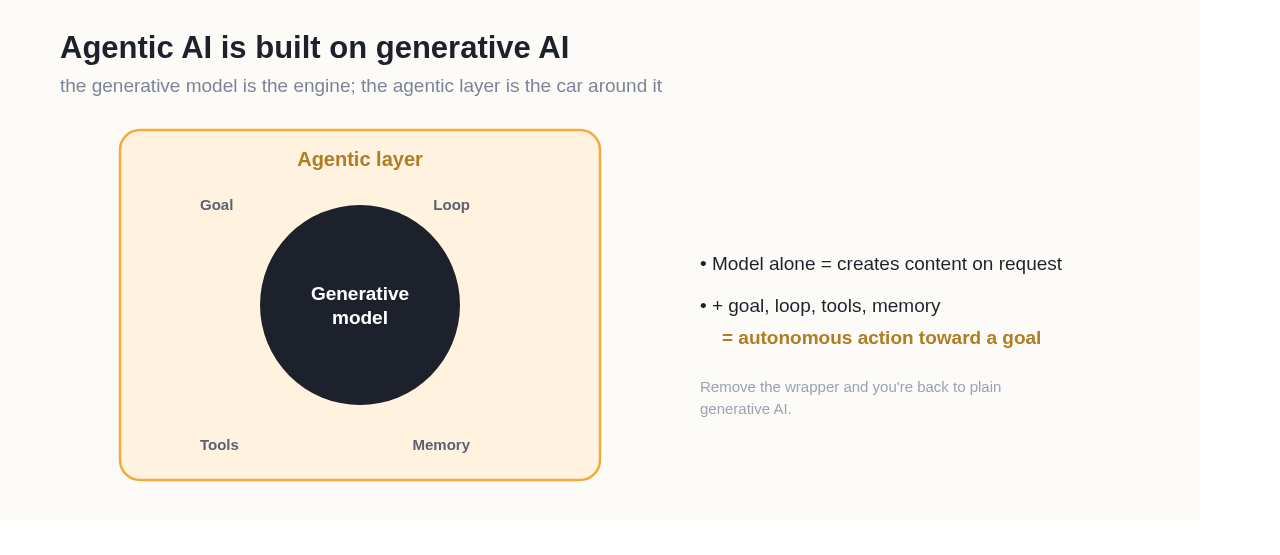 Agentic AI wraps a generative model in a goal, a loop, tools, and memory.
This is also where the related term AI agents comes in: an AI agent is a single autonomous unit, while "agentic AI" is the broader paradigm of building such systems, a distinction we cover in Agentic AI vs AI Agents. And the machinery that turns a generative model into a reliable agent (the loop, context, and tools) is the subject of harness engineering. Generative AI is the foundation the whole stack rests on; everything else is about giving it autonomy and a way to act.
Agentic AI in Practice: Three Concrete Shifts
The difference stops being abstract the moment you watch the same underlying model used both ways:
- Research. Generative: "Summarize this article I pasted." Agentic: "Research the top 5 competitors, pull their pricing, and build me a comparison table". The agent searches, opens pages, extracts data, and assembles the result without you feeding it each source.
- Coding. Generative: "Write a function that does X." Agentic: "Fix the failing test in this repo". The agent reads the codebase, edits files, runs the tests, sees the failures, and iterates until they pass.
- Operations. Generative: "Draft an onboarding email." Agentic: "Onboard this new hire". The agent provisions accounts, schedules the training, files the paperwork, and emails the welcome, coordinating across systems.
In every pair, the model is the same. What changes is whether a goal, a loop, tools, and memory are wrapped around it, and that wrapper is the difference between an answer and an outcome.
Common Misconceptions
A few mix-ups come up constantly:
- "Agentic AI is a smarter model." No, it's usually the same model with action machinery around it. The intelligence leap is often smaller than the autonomy leap.
- "If it uses an LLM, it's generative; if it's fancy, it's agentic." The dividing line isn't sophistication, it's whether the system takes actions toward a goal on its own.
- "Agentic AI replaces generative AI." It depends on generative AI. Remove the generative core and the agent has nothing to reason with.
- "A chatbot with a few buttons is agentic." Buttons that you click are still you driving. It's only agentic when the system chooses and executes the steps itself.
How to Tell Which One a Product Is Using
Marketing pages blur this constantly. Three questions cut through it:
- Does it take actions, or just produce text? If the output is always content you then act on, it's generative.
- Can it complete a multi-step task without you prompting each step? If yes, there's an agentic layer.
- Does it have tools and a sandbox? Tool use and isolated execution are tell-tale signs of an agent, not a pure generator.
If a product "uses AI to write X," it's generative. If it "uses AI to do X across your systems," it's agentic, and you should ask what guardrails it runs under.
Which Do You Need?
- Use generative AI when you want content or answers and you're happy to prompt for each one: drafting copy, summarizing documents, brainstorming, writing code snippets.
- Use agentic AI when you want an outcome rather than an output, a multi-step job done with minimal hand-holding: research-and-report, fix-and-test, monitor-and-act.
The honest framing: most "AI features" today are generative, and the shift everyone's talking about is the move from generating content to acting on it. If your problem is "I need something written," that's generative. If it's "I need something done," that's agentic.
From Understanding It to Actually Using It
Knowing the difference is the easy part. Building agentic AI is the hard part: you need the reasoning loop, the tools, persistent memory, and a sandbox to run it all safely, the machinery that turns a generative model into something that acts. Most people don't want to assemble that; they just want the outcome.
That's what Happycapy is for. It's an agent-native computer that runs in your browser: you describe a goal in plain language and watch an AI agent carry it out: research a market, build a slide deck, analyze a spreadsheet, ship a code change, inside a secure cloud sandbox, with the entire agentic harness already wired up. No install, no API keys, no infrastructure to manage. You stay the supervisor: you can watch each step on a visual desktop and step in whenever you want. This article is the theory of agentic AI; Happycapy is the one-click way to actually use it, powered by Claude and 150+ other models.
If you've been reading about AI that does work on its own and want to put one to work yourself, start free at happycapy.ai. Give it a real task and see the difference between "responds" and "acts" firsthand.
Frequently Asked Questions
Q: What's the simplest way to tell agentic AI and generative AI apart?
Ask what happens with no human in the loop. Generative AI does nothing until prompted; agentic AI keeps working toward its goal on its own. Generative AI responds; agentic AI acts.
Q: Can you have generative AI without agentic AI?
Yes, most AI tools today are purely generative: you prompt, they produce, they stop. The reverse doesn't hold: agentic AI needs a generative model as its reasoning core. So generative AI stands on its own, while agentic AI is generative AI plus the goal, loop, tools, and memory that let it act.
Q: What does adding an agentic layer to a generative model actually change?
It turns a system that describes into one that does. The same model that drafts a plan can now execute it, calling tools, running steps, and adjusting from the results, because the agentic layer gives it a goal, a loop, and the means to act. The model doesn't change; what changes is what it's equipped and allowed to do.
Q: Is agentic AI just generative AI with extra steps?
In a sense, yes. Agentic AI typically wraps a generative model in a goal, a loop, tools, and memory so it can take real actions. But that wrapper is the whole point: it turns a system that describes things into one that does them.
Q: Which is riskier, generative or agentic AI?
Agentic AI carries more operational risk because it takes actions, not just produces text. A wrong action can have real consequences. That's why agentic systems need guardrails like sandboxes, approvals, and limits that a pure generative tool doesn't.
Q: How do I start using agentic AI without building it myself?
Use a managed agent-native platform like Happycapy: it provides the loop, tools, memory, and sandbox out of the box, so you describe a goal in your browser and the agent executes it, no setup or infrastructure required.