
Agentic AI vs AI Agents: What's the Difference? (2026)
An AI agent completes a task; agentic AI runs the workflow. A clear breakdown of agentic AI vs AI agents: definitions, a side-by-side table, where generative AI fits, and real examples.
The difference between agentic AI and AI agents is one of scope: an AI agent is a single autonomous program that completes a task, while agentic AI is the broader paradigm of systems that plan, reason, and coordinate multiple agents and tools toward a larger goal. Put simply: an AI agent completes a task; agentic AI runs the workflow. The two terms are constantly mixed up, so this guide gives a clear definition of each, a side-by-side comparison, where generative AI fits in, and real examples of both.
The Short Answer
An AI agent is one autonomous unit: it perceives, reasons, and acts to accomplish a defined goal: book a meeting, triage a ticket, pull data from a site. Agentic AI is the umbrella term for the whole approach of building systems that behave autonomously, often by orchestrating several agents, tools, and data sources together toward an outcome a single agent couldn't reach alone.
So they're not opposites. Agentic AI is the bigger idea, and AI agents are the building blocks it's made of. A system with one agent is still "agentic" in spirit; a system that coordinates many agents is agentic AI in its fullest sense.
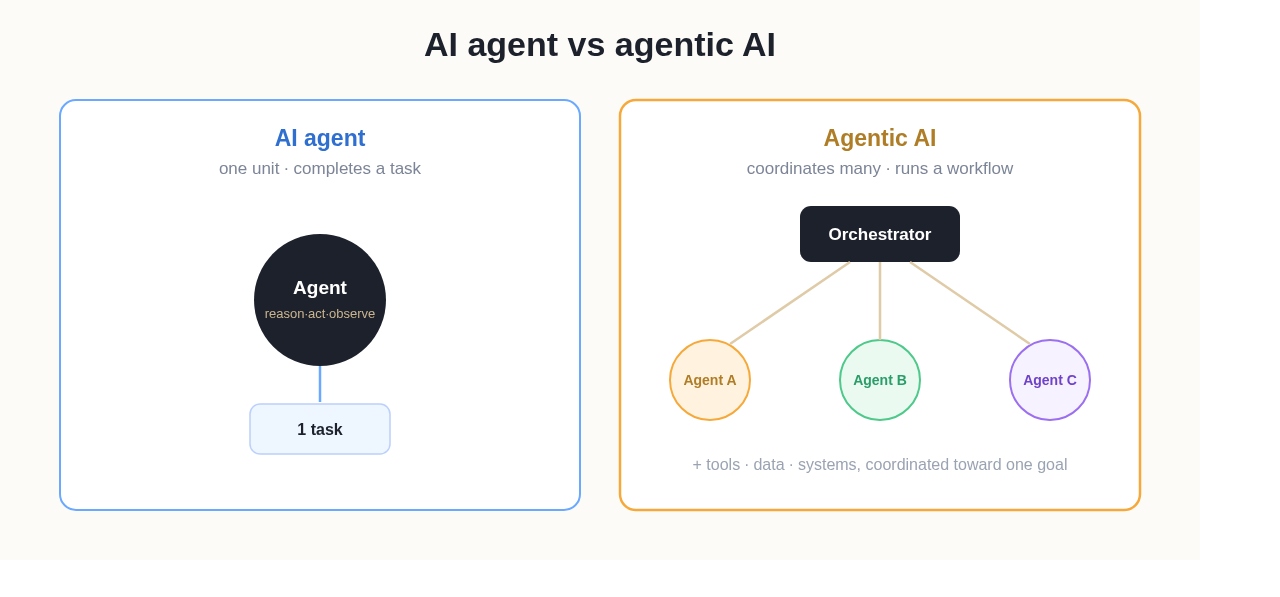 An AI agent completes a task; agentic AI coordinates many of them to run a whole workflow.
What Is an AI Agent?
An AI agent is a program that uses a model to perceive its situation, decide on an action, take it using tools, and observe the result, repeating until its goal is met. The defining traits are autonomy (it acts without step-by-step human instruction) and a bounded scope (it owns one task or a tight set of them).
Examples of single AI agents:
- A research agent that searches the web and returns a cited summary
- A coding agent that fixes a failing test in a repository
- A support agent that resolves a password-reset request end to end
Under the hood, every agent runs a loop (reason → act → observe), manages what it sees through context engineering, and lives inside a harness that gives it tools, memory, and a sandbox.
What Is Agentic AI?
Agentic AI is the broader discipline of building autonomous systems, usually by orchestrating multiple agents, tools, and enterprise systems so they plan and coordinate toward a goal that spans many steps. The key ingredient beyond "lots of agents" is coordination: planning, delegation, and goal-directed reasoning that ties the parts together.
Examples of agentic AI systems:
- An incident-response system where one agent detects an issue, another diagnoses it, and a third drafts the fix
- An onboarding workflow that provisions accounts, schedules training, and files paperwork across several systems
- A research-and-build pipeline where an orchestrator delegates sub-tasks to specialized sub-agents and assembles the result
Simply running several agents in parallel is not agentic AI on its own. Without coordination and planning, it's just several agents. The "agentic" part is the orchestration layer.
Agentic AI vs AI Agents: Side by Side
| AI agent | Agentic AI | |
|---|---|---|
| Scope | One task or a tight set | A multi-step goal or workflow |
| Structure | A single autonomous unit | A coordinated system of agents + tools |
| Decision-making | Decides within its task | Plans and delegates across tasks |
| Coordination | None required | The defining feature |
| Analogy | A specialist | The team and its manager |
| Best for | Well-defined, repeatable tasks | Open-ended, cross-system outcomes |
Where Does Generative AI Fit?
Generative AI is the underlying capability (models that produce text, code, or images) while AI agents and agentic AI are about acting, not just generating. A generative model answers when prompted; an AI agent uses that model to take actions in a loop; agentic AI coordinates many such agents toward a goal. Think of it as a progression in autonomy.
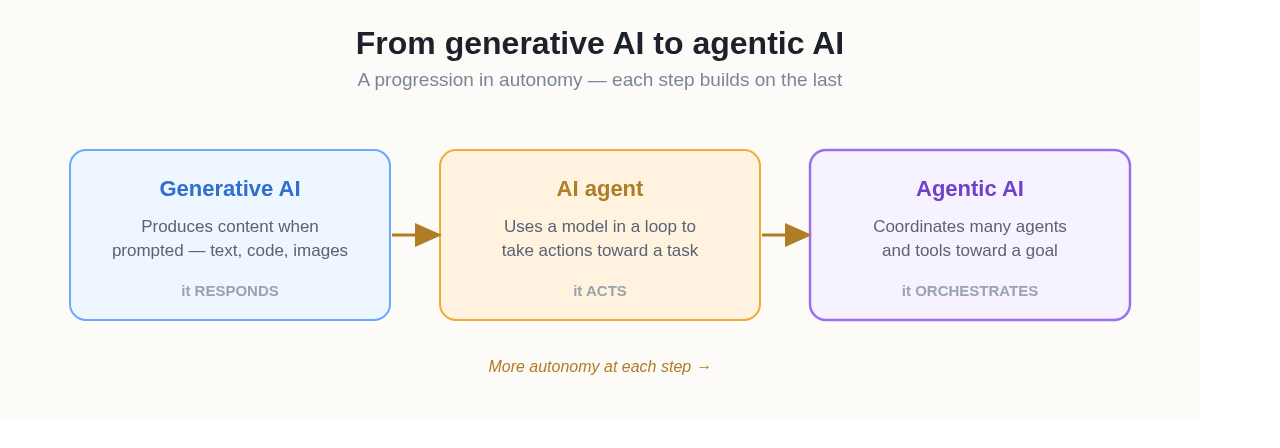 Increasing autonomy: generative AI produces, an agent acts, agentic AI orchestrates.
This is why a chatbot isn't an AI agent: a chatbot generates replies, but it doesn't autonomously take actions toward a goal. The moment you give that model tools and a loop so it can do things on its own, it becomes an agent.
Which One Do You Actually Need?
Match the approach to the problem:
- Use a single AI agent when the job is well-defined and self-contained, a task you could describe in one sentence and check the result of.
- Use agentic AI when the outcome spans multiple steps, systems, or specialties that need to be coordinated, where one agent's output feeds another's input.
The one-sentence litmus test: if you can describe the whole job in a single sentence and check the result in one look, you want an AI agent. If getting there means several specialists handing work back and forth, you want agentic AI. (And if it's just "answer this question," you only need generative AI, no agent at all.)
In practice you don't have to build either from scratch. A platform like Happycapy lets you run AI agents, and orchestrate several together, from your browser, with the loop, context management, tools, and sandbox already handled, so you can focus on the goal rather than the plumbing.
Frequently Asked Questions
Q: Are agentic AI and AI agents the same thing?
No, but they're closely related. An AI agent is a single autonomous program that completes a task; agentic AI is the broader paradigm of autonomous systems, usually built by coordinating multiple agents and tools toward a larger goal. Agents are the building blocks; agentic AI is the system they make up.
Q: What is the main difference between an AI agent and agentic AI?
Scope and coordination. An AI agent owns one task and acts on its own within that scope. Agentic AI plans and coordinates across many tasks, agents, and systems to reach a multi-step goal. An agent completes a task; agentic AI runs the workflow.
Q: Is agentic AI just multiple AI agents?
Not by itself. Running several agents in parallel isn't agentic AI unless there's coordination: planning, delegation, and goal-directed reasoning that ties them together. The orchestration layer is what makes a collection of agents "agentic."
Q: How is agentic AI different from generative AI?
Generative AI produces content (text, code, images) when prompted. Agentic AI uses generative models to act autonomously and coordinate toward a goal. Generative AI is the underlying capability; agentic AI is an application of it focused on autonomous action.
Q: Is ChatGPT an AI agent or agentic AI?
A plain chatbot like the basic ChatGPT interface is generative AI. It responds to prompts. It becomes an AI agent when given tools and a loop so it can autonomously take actions toward a goal, and part of an agentic AI system when several such agents are coordinated together.