
AI Agent for SEO: Automating the Entire Workflow, Not Just Advice
Delegate the SEO goal: the agent runs keyword research, competitor gaps, briefs, and link audits in one session.
What an AI Agent for SEO Actually Does (and How It Differs from Everything Else You've Tried)
Most SEO professionals spend more time managing tools than doing strategy. You have one dashboard for keyword research, another for competitor analysis, a third for site auditing, and a writing environment that talks to none of them. Stitching those steps together (exporting CSVs, copy-pasting data, reformatting outputs) is the invisible tax that slows every content cycle down. An AI agent for SEO changes that equation: instead of you operating a chain of tools, you delegate a goal and the agent runs the workflow.
This post explains exactly what that looks like in practice: the workflows an SEO agent can run end-to-end, how it differs from dedicated SaaS platforms like Ahrefs or Semrush and from simply asking ChatGPT for advice, a concrete worked example producing a content brief from scratch, and the honest limitations you need to know before you rely on one.
What Is an AI Agent for SEO?
An AI agent for SEO is software that combines a large language model with the ability to take actions: browsing live web pages, running code, reading and writing files, and chaining multiple steps together in a single session without requiring a human prompt at each stage.
That last part is what separates an agent from a chatbot. When you ask ChatGPT "what should my content brief include?", it gives you a framework based on its training data, static, generalized, disconnected from your actual keyword and competitive landscape. When you give an SEO agent the same goal, it goes to find the answer: it searches for the target keyword, reads the top-ranking pages, identifies what they cover and what they miss, and then writes a brief calibrated to that specific SERP. It acts on the world rather than describing it.
The architecture behind this is usually called an agent loop or harness: the model receives a goal, decides on a first action (say, searching Google for the top 10 results), receives the output, decides on the next action (read the content of each result), continues until it has enough information, then writes the deliverable. Frameworks like LangChain and CrewAI provide the scaffolding; the browsing and execution happen in a sandboxed environment to keep live data access safe and reproducible.
For a deeper look at how agent loops are engineered under the hood, the harness engineering guide covers the mechanics in detail.
The SEO Workflows an Agent Can Run End-to-End
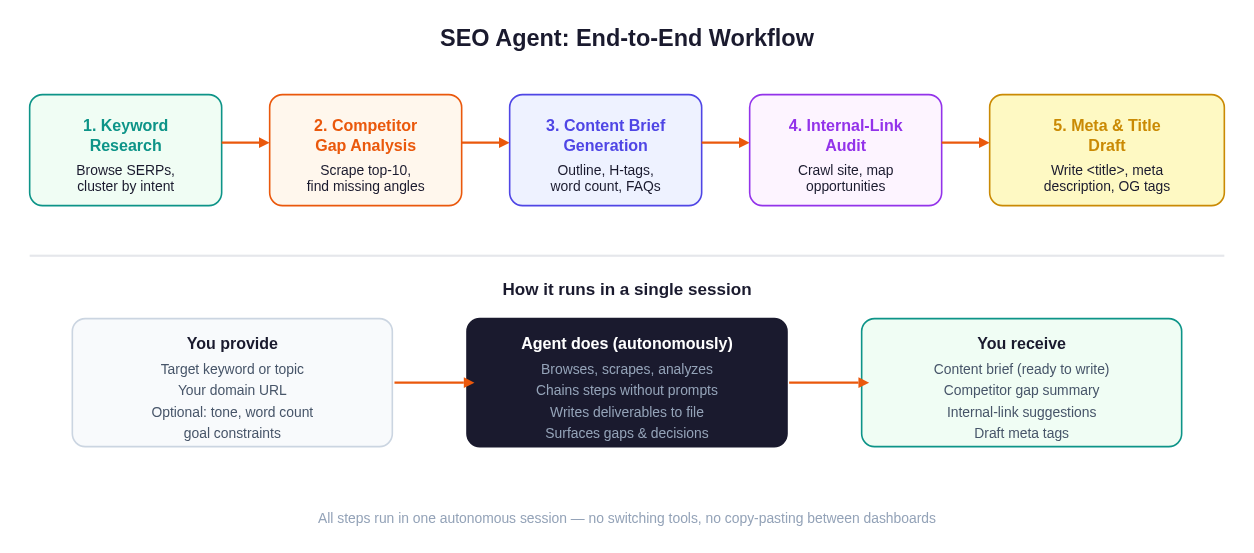 An SEO agent chains five major tasks in one session, from keyword clustering through meta drafting, without requiring a human to hand off between steps.
Keyword Research and Intent Clustering
The agent searches for seed keywords across multiple angles: related queries, People Also Ask, autocomplete suggestions, and competitor page titles. It groups the results by search intent (informational, commercial, navigational, transactional) and surfaces a prioritized list, often with rough volume and competition signals scraped from visible SERP metadata. This replaces the workflow of pulling data from a keyword tool, exporting to a spreadsheet, and manually tagging intent.
Competitor Gap Analysis
Given a target keyword and your domain, the agent reads the top-ranking pages for that keyword and maps what topics, headings, and angles they cover. It then compares that coverage to any existing content you have on the topic and identifies the gaps: questions the competitors answer that you don't, semantic angles missing from your content, and structural differences in how they present the information. This is the step that typically requires the most manual effort in a traditional SEO workflow, and it's where agents save the most time.
Content Brief Generation
Pulling the keyword research and gap analysis together, the agent produces a structured brief: a recommended title, target word count based on competitive benchmarks, proposed H2 and H3 structure, key questions to answer, semantic terms to include, suggested internal links, and notes on differentiation. The brief is a working document a writer or content team can use directly.
Internal-Link Audit and Opportunity Mapping
The agent crawls your site (or a sitemap you provide), indexes what pages exist and what they're about, and maps where the target article could receive links from existing content and where it could link out. Internal linking is consistently undertreated in most content programs because it requires manually holding the whole site structure in mind; an agent can do this systematically at scale.
Meta Title and Description Drafting
Drawing on the keyword data, competitor analysis, and the brief, the agent drafts several candidate <title> tags and meta descriptions, each tuned for click-through and keyword presence. It can also generate Open Graph tags, structured-data JSON-LD snippets, and social sharing copy in the same pass.
Agent vs. Point Tools vs. "Ask ChatGPT": The Core Differences
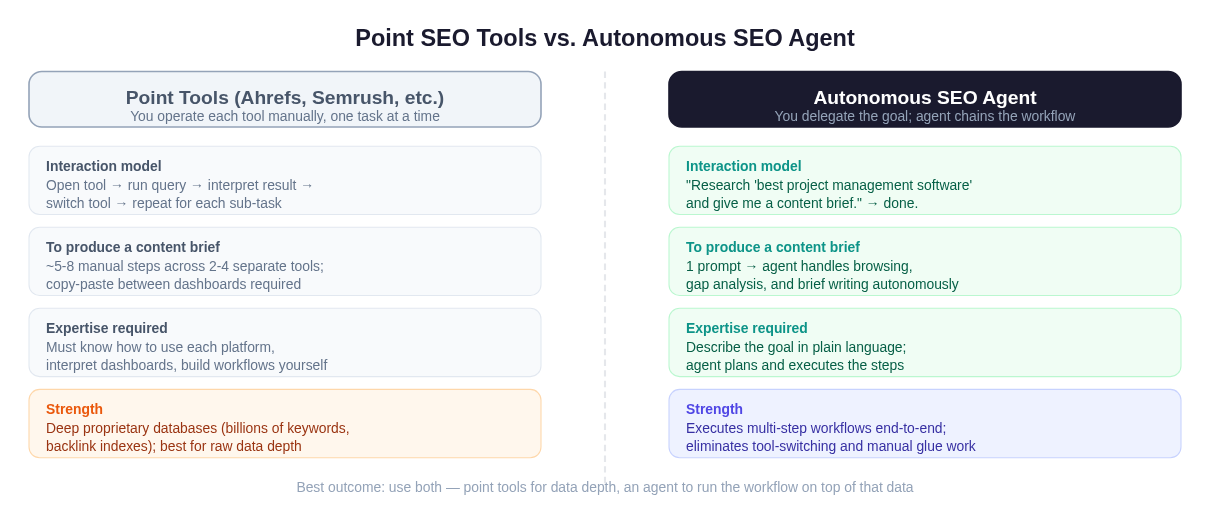 The key distinction: point tools give you data you have to act on; an agent runs the workflow. Both have a role.
Point Tools (Ahrefs, Semrush, and their category)
Platforms like Ahrefs and Semrush are databases with interfaces. Their value is data depth and precision: Semrush tracks tens of billions of keywords; Ahrefs maintains one of the largest live backlink indexes in the industry. These are genuine competitive moats. Both platforms have also added AI-assisted features in recent years (content score suggestions, AI-generated briefs, chat interfaces), but the fundamental model remains the same: you open the tool, run a query, interpret the result, decide what to do next, and move to the next task.
The overhead is significant. Getting from a seed keyword to a finished content brief using traditional tools means working across at least two or three platforms, running multiple queries, exporting data, reconciling formats, and assembling the final document yourself. The tools are powerful; the workflow is manual.
An SEO agent does not replace the data those platforms hold. But it collapses the workflow layer (the steps that connect data to deliverable) into a single delegatable task. For a detailed comparison of dedicated SEO automation tools and how they stack up against one another, see the best SEO automation software guide (that's the companion piece to this one; it covers point-tool evaluations that fall outside the scope of this article).
"Ask ChatGPT for SEO Tips"
Asking a general-purpose chatbot for SEO guidance is useful for learning and ideation. It's not useful for producing competitive research. A chatbot with no live browsing access cannot tell you what's currently ranking for your keyword, what those pages actually say, where the gaps are, or what a competitive word count looks like today. Its knowledge is frozen at a training cutoff, and it has no visibility into your specific domain or content inventory.
Even with browsing enabled, a chatbot in standard conversation mode requires you to direct each step: "Now look at this URL. Now compare it to this one. Now write me a brief." You're the workflow engine. An agent runs that loop autonomously.
The difference between an agent and a chatbot is the same as the difference between delegating a task and having a conversation about a task. Both have value; they serve different purposes. For a deeper treatment of this distinction, ai agent vs chatbot covers the architectural differences directly.
Worked Example: Agent Produces a Content Brief from One Keyword
Here is what a session actually looks like when you use an AI agent to build a content brief for the keyword "project management software for remote teams."
Input to the agent:
"Research the keyword 'project management software for remote teams.' Identify the top-ranking pages, what they cover, what's missing, and produce a content brief for a 1,800 to 2,200 word article targeting this keyword for [yourdomain.com]. Include title options, H2 structure, key questions to answer, and internal-link suggestions based on our site."
What the agent does (autonomously, without further prompting):
- Searches the keyword and reads the top 10 SERP results, noting the current page-one landscape.
- Reads the full content of the top three to five ranking articles, extracting their heading structures, topics covered, word counts, and any data they cite.
- Identifies gaps: for example, most top-10 articles cover feature lists but none address asynchronous communication norms or time-zone management in depth. These become differentiation angles.
- Crawls your sitemap to find existing articles that could link to the new piece (e.g., "how to onboard a remote employee" and "best video conferencing tools").
- Outputs a structured document: recommended title (with two alternates), word count target (1,900 based on competitive average), H2 and H3 outline, a list of 12 questions the article should answer, semantic terms to include, three internal-link insertion points in existing content, and three meta description variants.
Time elapsed: Typically 4 to 8 minutes for this workflow, depending on the number of pages crawled and model latency.
What you get: A brief you can hand to a writer immediately, with competitive context already baked in.
This is precisely the kind of workflow Happycapy is built to run. Happycapy is a browser-based AI agent sandbox that can browse live SERPs, read competitor pages, run analysis code, and write deliverables, all in one session. You give it the goal; it runs the steps. Start free at happycapy.ai
What to Look for in an AI Agent for SEO
Not all tools marketed as "SEO AI agents" are actually agents. Some are glorified content generators with a keyword field. Here's what distinguishes a genuine autonomous SEO agent:
Live browsing capability. The agent must be able to read current SERP results and competitor pages, not just generate text from training data. If it can't browse, it's a chatbot with a content template.
Multi-step chaining without manual re-prompting. A real agent completes sub-tasks and passes results to the next step automatically. You should not need to shepherd it through each stage.
File and document output. The agent should be able to write structured deliverables (briefs, audit reports, meta drafts) to files you can download and use. Output that only lives in a chat window is hard to operationalize.
Transparency about data sources. You should be able to see which pages the agent read, what data it pulled, and where its conclusions come from. Opaque outputs that you can't trace are a liability in professional SEO work.
Sandboxed execution. If the agent can run code (useful for processing crawl data, computing word counts, analyzing log files), that execution should happen in an isolated environment, not on your local machine.
Integration flexibility. The best setups let the agent pull data from your existing tools (through APIs or MCP connectors) so it augments your stack rather than replacing it entirely.
For a broader look at how to automate tasks with AI agents across different workflows, not just SEO, that guide covers the delegation patterns that apply across use cases.
Honest Limitations of AI Agents for SEO
AI agents for SEO are genuinely useful. They are not a replacement for SEO expertise or strategic judgment. Here is where they fall short:
They do not have access to real search volume or backlink data unless you give it to them. An agent browsing live SERPs can see what's ranking and approximately what results look like, but it cannot tell you that a keyword gets 14,000 monthly searches with a keyword difficulty of 62. That data lives in proprietary tool databases (Ahrefs, Semrush, Google Search Console). The agent is a workflow runner; for precise quantitative data, you still need a data source.
Content quality varies with niche depth. For competitive niches where nuance matters (medical, legal, financial, highly technical B2B), agent-generated briefs and drafts require meaningful human review. The agent can get the structure right while missing the substantive insight that makes a piece authoritative.
Strategy is still yours. The agent can tell you what's on page one. It cannot tell you whether pursuing that keyword is worth it given your domain authority, competitive position, budget, and business objectives. SEO strategy is a judgment call that requires context the agent doesn't have.
Verify factual claims and statistics. Agents can and do hallucinate citations and statistics, especially when synthesizing information from multiple sources. Any data point in an agent-generated document that you intend to publish should be verified against the original source.
Speed is not always faster end-to-end. An agent session for a content brief might take five minutes of agent time. But if the output requires significant editing because the niche is specialized, your total time investment (setup, review, revision) may not be dramatically lower than a skilled practitioner doing it manually. The efficiency gain is most reliable for high-volume, repeatable tasks.
If you want to understand how agents generate and structure complex reports more broadly, ai report generator covers that capability in more depth.
How to Run an AI Agent for SEO
Getting started is simpler than the underlying technology suggests:
1. Choose your environment. You can use a general-purpose agent platform like Happycapy (which gives you a cloud sandbox with browsing, code execution, and file output), build a custom workflow using a framework like n8n or LangChain, or use a specialized SEO agent product. Each trade-off is different: general platforms give you flexibility; specialized tools give you pre-built SEO workflows; custom builds give you full control at higher setup cost.
2. Start with one workflow. Don't try to automate your entire SEO program on day one. Pick the most time-consuming single task (usually competitive gap analysis or content brief generation) and build your first agent workflow around that.
3. Provide the context the agent needs. The quality of the output scales with the quality of the input. Give the agent your target keyword, your domain URL, any style or tone guidelines, and the content goal. The more context it has, the more calibrated the output.
4. Review the output against your sources. Treat the first agent run as a draft, not a final deliverable. Check that the competitor analysis reflects what you actually see on the SERP, that the brief's structure matches your content strategy, and that any statistics the agent cites are accurate.
5. Iterate the prompt, not just the content. If the first output misses your standard, refine the instruction. A slightly better-specified goal often produces dramatically better output. This is where the skill of working with agents pays off. See how to automate tasks with AI agents for more on effective delegation patterns.
FAQ
What is an AI agent for SEO? An AI agent for SEO is software that autonomously runs multi-step SEO workflows (such as keyword research, competitor gap analysis, content brief writing, and meta drafting) in a single session, without requiring a human to direct each individual step. It acts on live data by browsing web pages, rather than generating responses from static training data alone.
How is an SEO agent different from Ahrefs or Semrush? Ahrefs and Semrush are data platforms: they provide deep keyword, backlink, and competitive data that you then act on manually. An SEO agent is a workflow runner: it chains tasks together and produces deliverables, but it typically relies on browsing for live data rather than proprietary indexed databases. The most effective setups use both: point tools for data depth, an agent to run the workflow on top of that data.
How is an SEO agent different from asking ChatGPT? A chatbot in standard chat mode gives you advice based on training data. It can't browse the live SERP for your keyword, read your competitors' actual pages, or produce a brief grounded in the current competitive landscape. An agent takes actions (browsing, reading, writing) and chains them autonomously. The difference is between discussing a task and delegating it.
Can an AI agent write the actual article, not just the brief? Yes, most agents can continue from the brief to a full draft. Whether that draft is publishable depends heavily on the niche, the quality of the brief, and how much human editing you apply. Most professionals use agents for the research and structure phase and apply more oversight to the writing phase.
Do I need technical skills to use an SEO agent? Not for general-purpose platforms like Happycapy, which are designed to accept natural-language goals. Building custom agent workflows in frameworks like LangChain or n8n does require technical knowledge. The trade-off is flexibility versus ease of setup.
Is SEO agent output good enough to publish directly? For competitive or authoritative niches: no, not without human review. For lower-stakes informational content at scale, some teams do publish with light editing. The standard practice is to use agent output as a high-quality first draft that a human then refines, fact-checks, and adds original perspective to.
What data does an SEO agent have access to? It depends on the platform and what you connect. A general-purpose agent with a browser can read live SERP results and public web pages. It does not automatically have access to your Google Search Console data, your Ahrefs account, or your CMS; those require explicit integration. Purpose-built SEO agents often include data integrations as part of their product.
How much does it cost to run SEO workflows with an agent? Costs vary widely. General-purpose agent platforms often have free tiers suitable for experimentation (Happycapy offers a free tier). Purpose-built SEO agent tools typically start at $49 to $99/month. Custom builds using API providers have variable costs based on LLM usage and the volume of tasks you run.
What is the biggest risk of relying on SEO agents? Over-trusting the output. Agents are fast and produce plausible-looking work, which can create false confidence. The risks are factual errors in content, competitive analysis that doesn't reflect the nuance of your niche, and strategic decisions made on incomplete data. Using agents as accelerators, with human strategy and review, consistently outperforms treating them as autonomous decision-makers.