Treatment Plans
Generate detailed, professional medical treatment plans for clinical use
Vetting scorecard
Each dimension is scored against its own maximum; together they sum to the overall grade (out of 100).
Input → output capabilities
| doc | summary | markdown | docx | chart | json | |
|---|---|---|---|---|---|---|
| text | 1 | 1 | - | 3 | - | - |
- | - | - | - | - | - | |
| docx | - | - | - | - | - | - |
| csv_xlsx | - | - | - | - | - | - |
| image | - | - | - | - | - | - |
| url | - | - | - | - | - | - |
Rows are accepted inputs, columns are produced outputs; each cell counts supported conversions.
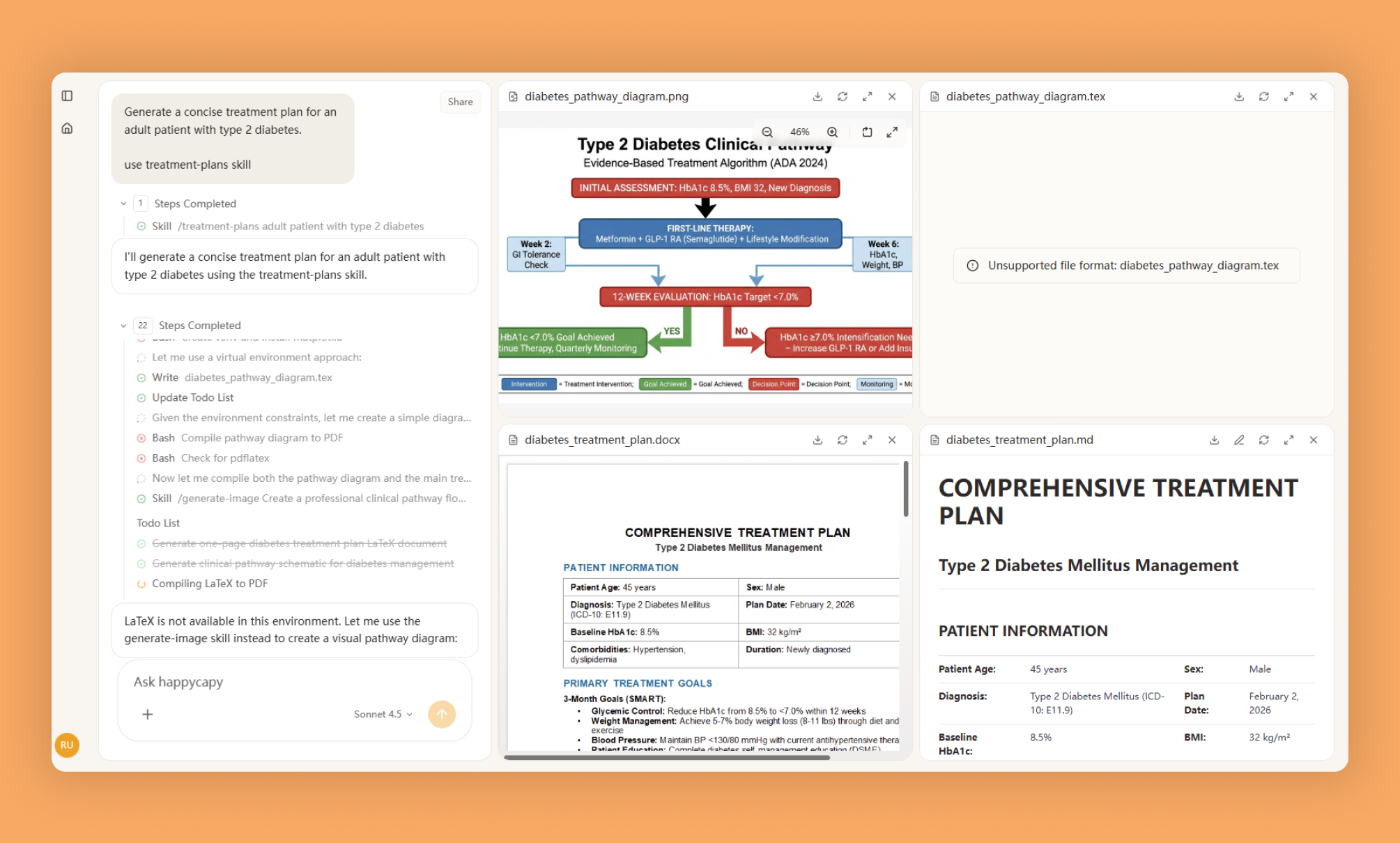
Treatment Plans generates structured medical documentation that saves healthcare providers hours of administrative work while ensuring comprehensive, evidence-based care plans following clinical standards.
What Is This?
- Automated generation of complete treatment plans covering patient assessment, diagnosis, interventions, medication management, and follow-up schedules
- Structured documentation following SOAP notes format, ICD coding references, and evidence-based protocols
- Support for multiple specialties including primary care, mental health, physical therapy, and chronic disease management
Why Use It?
- Save time on documentation — Generate comprehensive plans in minutes instead of hours
- Ensure completeness — Structured format captures all critical elements, reducing missed components
- Standardize across providers — Consistent formatting improves care team communication and handoffs
- Follow evidence-based guidelines — Plans reference current clinical protocols ensuring best practices
How to Use It?
Provide patient information, diagnosis, and treatment goals. The skill generates a comprehensive treatment plan.
Generate treatment plan for Type 2 diabetes patient with hypertensionCreate mental health treatment plan for anxiety and depressionDevelop physical therapy plan for post-ACL reconstructionFor chronic disease management:
Create comprehensive care plan for COPD patientFor mental health:
Generate therapy treatment plan for PTSD using evidence-based approachesFor rehabilitation:
Develop post-stroke rehabilitation plan with functional goalsWhen to Use It?
- Creating comprehensive primary care treatment plans or mental health therapy protocols
- Developing physical therapy rehabilitation plans or chronic disease management documentation
- Post-hospitalization care planning and complex patient coordination
Important Notes
- Generated plans require clinical judgment and customization; they cannot replace clinical assessment or reasoning
- Must verify medication dosing and interactions separately, and comply with institutional policies and HIPAA requirements
- Plans require provider review and approval before clinical use
Try It in Happycapy
- Open Happycapy in your browser (no install or signup needed to try).
- Describe what you want in one sentence, for example: "Generate a comprehensive treatment plan for a newly diagnosed Type 2 diabetes patient with hypertension including lifestyle modifications, medication titration, and monitoring protocols."
- Get your structured treatment plan ready to customize for your patient.
Frequently asked questions
What is the Treatment Plans skill in Happycapy?+
The Treatment Plans skill in Happycapy generates detailed, professional medical treatment plans suitable for clinical use. It helps healthcare providers create comprehensive, structured documentation that meets clinical standards and improves patient care workflows.
How can an AI agent help create treatment plans?+
An AI agent can streamline treatment plan generation by analyzing patient information and clinical guidelines to produce standardized, evidence-based plans quickly. This reduces administrative burden on clinicians and ensures consistency across documentation.
Can Happycapy's treatment plan generator be customized for different medical specialties?+
Yes, Happycapy's Treatment Plans skill can be configured to accommodate various medical specialties and clinical contexts. The AI agent adapts the structure and content to match specialty-specific requirements and protocols.
What are the benefits of using automated treatment plan generation?+
Automated treatment plan generation saves time, reduces errors, ensures regulatory compliance, and improves documentation quality. Happycapy enables healthcare teams to focus on patient care rather than administrative documentation tasks.
How does the AI agent ensure treatment plans meet clinical standards?+
The AI agent in Happycapy is designed to generate treatment plans that follow established clinical guidelines and best practices. It produces professional-grade documentation that meets healthcare documentation requirements and supports quality patient outcomes.
More Skills You Might Like
Explore similar skills to enhance your workflow
Get started with Treatment Plans on Happycapy
Generate detailed, professional medical treatment plans for clinical use. Treatment Plans is a skill on Happycapy, the agent-native computer for building with AI — sign up free to add and run it, no local setup required.