
Data Storytelling
Transform raw data into compelling, visually engaging narratives and insights
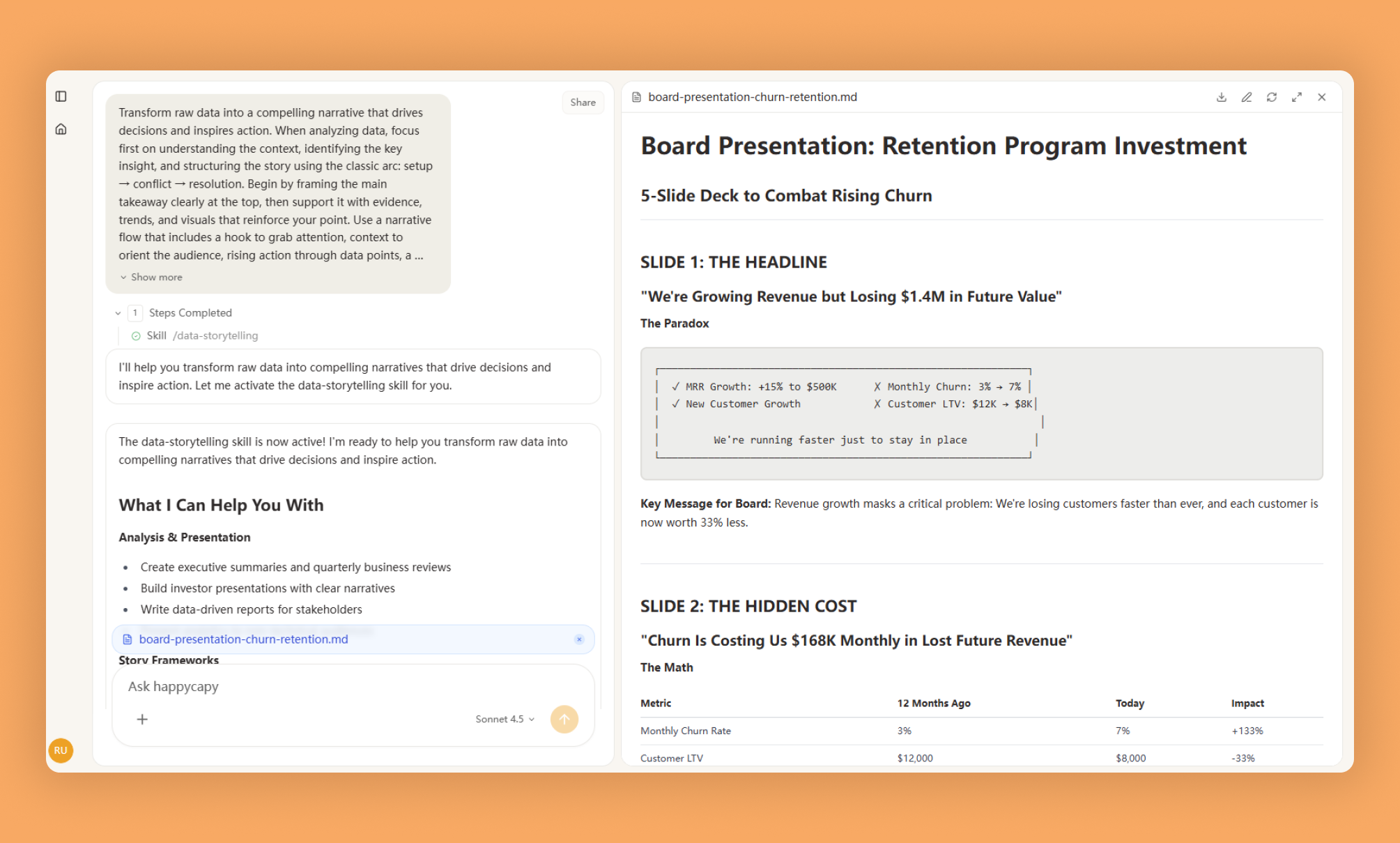
What Is This?
Overview
Data Storytelling transforms raw numbers into compelling narratives that drive understanding and action. Rather than presenting data in isolation, it helps you craft stories that reveal insights, highlight patterns, and make information meaningful to your audience.
The skill analyzes data to identify meaningful patterns, then structures findings into coherent stories with clear beginnings, development, and conclusions. It goes beyond simple reporting to provide context, interpretation, and actionable recommendations. Every dataset contains potential stories about trends, anomalies, or relationships, and this approach helps identify which story matters most for your audience.
Visualization guidance is central to the methodology. Different data stories require different chart types, and the skill helps match visualization approaches to narrative goals, recommending specific chart types and design principles that enhance comprehension.
Who Should Use This
Data Analysts: Transform analysis results into presentations that stakeholders can understand and act upon.
Business Professionals: Communicate performance metrics or strategic insights through data-driven narratives.
Researchers: Present findings with compelling narratives that highlight significance and implications.
Product Managers: Tell product stories through user data, feature adoption, or performance metrics.
Marketing Professionals: Communicate campaign performance or customer insights through data narratives.
Why Use It?
Problems It Solves
Information Overload: Raw data overwhelms audiences who cannot identify what matters. Data Storytelling distills information to highlight the most important insights in a narrative framework.
Lack of Context: Numbers without context fail to drive action. The skill provides interpretation that helps audiences understand what data means and why it matters.
Poor Visualization Choices: Wrong chart types confuse rather than clarify. The skill recommends appropriate visualizations matched to data type and narrative goals.
Disconnected Findings: Presenting data points in isolation misses the bigger picture. The skill structures findings into coherent narratives connecting individual insights into meaningful conclusions.
Core Highlights
- Narrative Structure: Applies storytelling principles including setup, development, and resolution to data presentation.
- Pattern Identification: Analyzes data to find trends, outliers, and correlations worth highlighting.
- Visualization Matching: Recommends specific chart types based on data characteristics and communication goals.
- Audience Consideration: Tailors narrative complexity and technical depth to audience knowledge level.
- Actionability Focus: Structures conclusions around concrete next steps or decisions.
How to Use It?
Basic Usage
Provide your dataset or describe the data you are working with. The skill analyzes it to identify patterns and potential stories, helps you select the most compelling narrative angle, and structures findings accordingly.
1. Provide or describe your dataset
2. Identify key patterns, trends, or insights
3. Select primary narrative angle
4. Structure findings into story arc
5. Recommend appropriate visualizations
6. Draft narrative with data support
Specific Scenarios
Performance Analysis: Analyze quarterly metrics, identify trends, structure as a progress story, use line charts, and recommend actions based on findings.
Comparison Report: Compare segments, highlight significant differences, use bar charts, and recommend strategic focus based on findings.
User Behavior Study: Analyze usage patterns, identify drop-off points, use funnel visualization, and suggest improvements.
Real-World Examples
Product Adoption: Feature adoption data revealed sign-ups increased while actual usage remained flat. A funnel visualization showed the drop-off between sign-up and first use, leading to onboarding improvement recommendations.
Sales Performance: Quarterly data showed strong overall growth but significant regional disparities. Bar charts and a map visualization highlighted the contrast, with best practices from successful regions identified for broader application.
Customer Satisfaction: Declining survey scores were isolated to one customer tier. A segmented line chart highlighted the problem cohort, with targeted recommendations for that specific segment.
Advanced Tips
Use progressive disclosure by starting with high-level insights then diving into supporting details. Layer context by comparing data to historical baselines or industry benchmarks. Anticipate questions by addressing alternative interpretations within your narrative. Annotate visualizations to guide attention to key data points.
When to Use It?
Executive Reporting, Research Communication, Product Analytics, Marketing Performance, Customer Insights, Strategic Planning, and Change Management all benefit from structured data narratives that connect findings to decisions.
Important Notes
Requirements
Access to underlying data, either as files or detailed descriptions. Understanding of what questions the analysis should answer and knowledge of the target audience's familiarity with technical concepts.
Usage Recommendations
Do: Start with the insight, provide context through comparisons, choose visualizations that support your narrative, make findings actionable, and test comprehension with representative audience members.
Don't: Overwhelm with every available metric, manipulate scale or cherry-pick timeframes, use undefined jargon, ignore outliers, or omit data sources.
Limitations
Data Quality Dependent: Narrative quality cannot exceed the quality of underlying data.
Interpretation Subjectivity: Different analysts may identify different stories in the same dataset.
Audience Variability: Technical depth, context needs, and preferred visualization styles vary by audience background.
FAQ
Q: How does the Data Storytelling skill help visualize complex data?
The Data Storytelling skill transforms raw data into visually engaging narratives, making it easier to understand trends and insights using the Happycapy platform.
Q: Can I use this skill with other Happycapy Skills for deeper analysis?
Yes, you can combine Data Storytelling with other Skills in Happycapy to enhance your data analysis and create more comprehensive reports.
Q: Is the Data Storytelling skill compatible with AI agent workflows?
Absolutely, this skill integrates seamlessly with AI agent workflows, allowing automated generation of data-driven stories and presentations.
Q: What data formats are supported by the Data Storytelling skill?
The skill supports common data formats such as CSV and JSON, making it easy to import your datasets for storytelling within the Happycapy AI agent ecosystem.
Q: How can I access the source code for the Data Storytelling skill?
You can find the source code for this skill on the official Happycapy Skills GitHub repository, which allows you to review, customize, or contribute to its development.
More Skills You Might Like
Explore similar skills to enhance your workflow
Treatment Plans
Generate detailed, professional medical treatment plans for clinical use
LLM Council
Multi-model LLM council with live dashboard for querying multiple AI models simultaneously and synthesizing consensus
Create Design System Rules
Generate custom design system rules for Figma workflows
Supabase Postgres Best Practices
Comprehensive guide for optimizing Postgres database performance and security using Supabase best practices
World Class Carousel
Generate world-class Instagram carousel content with AI-generated visuals, precise typography, and optimized captions
Video Frames
Efficiently extract high-resolution individual frames from video files using powerful ffmpeg command-line tools