
The Best Manus Alternative Right Now (And When to Switch)
One clear answer to 'what should I switch to from Manus', with an honest case for and against.
The Best Manus Alternative Right Now (And When to Switch)
If you're here, you've already decided Manus isn't the right tool for you, or at least you're seriously questioning it. You want a clear answer: which single alternative is worth switching to, and is it actually better for your specific situation? This page answers that directly: one focused recommendation, an honest head-to-head comparison, the cases where Manus still wins, and what you need to know before migrating.
(Looking for a wider field of options? The full roundup lives at Manus AI alternatives: every tool compared. This page is for people who want a direct decision, not a long list.)
What Manus Is, In Brief
Manus is an autonomous AI agent that takes a high-level goal ("research this market", "build me this prototype", "find and compile this data") and independently breaks it into steps, then executes them inside a cloud-hosted sandbox. It browses the web, runs code, fills forms, and produces deliverables without you hovering over every click. When it works, it feels like having a capable assistant who just runs with a brief.
The product launched in early 2025 with significant buzz: invite-only access, a viral moment on social media, and a reputation for tackling the kinds of multi-step research and prototyping tasks that simpler AI tools give up on. It earned that reputation. Manus genuinely handles complex, long-horizon tasks better than most of the market.
But Manus has real friction points, and they're consistent enough across user reports that they've spawned an entire category of people actively searching for a Manus alternative. Understanding those friction points is how you figure out whether you actually need to switch, and what to switch to.
The Four Reasons People Actually Leave Manus
Not every Manus frustration is equal. Before assuming you need an alternative, it's worth knowing which of these applies to you, because the right switch depends on the specific problem.
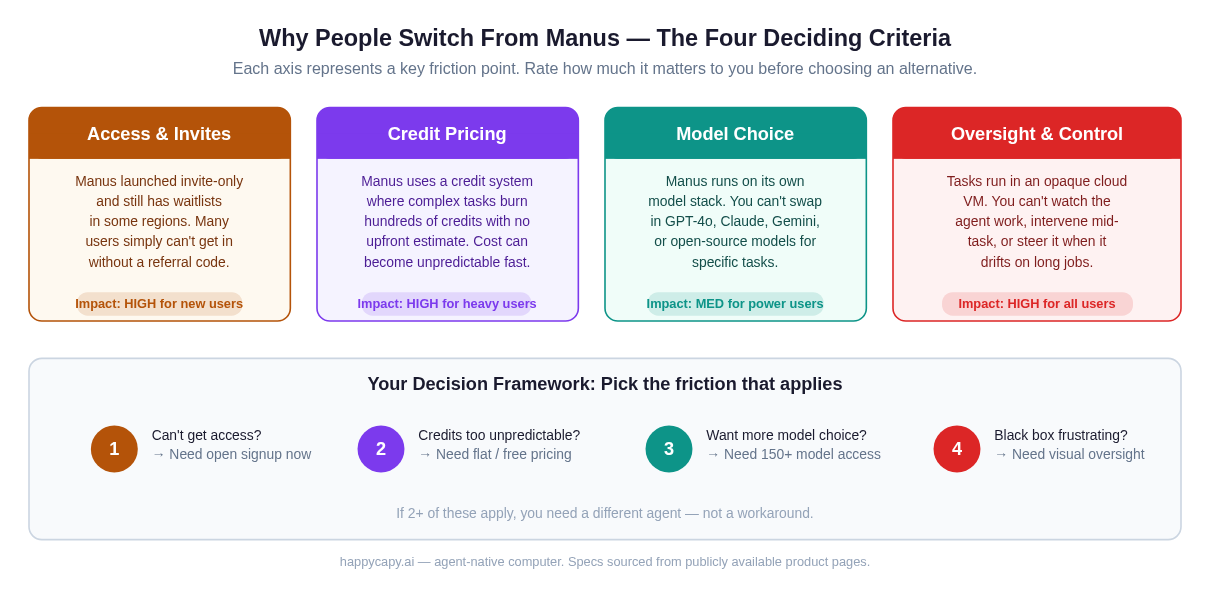 The four friction points behind most Manus switches. If two or more apply to you, you need a different tool, not a workaround.
1. You Can't Get In
Manus launched invite-only and access has remained uneven. In some regions and accounts, waitlists still apply. If you need an autonomous agent today and you're sitting in a queue, the product's quality is irrelevant; you need something you can actually use.
2. The Credit System Is Unpredictable
Manus meters work in credits. A simple task might cost a handful; a complex research and synthesis job can burn through hundreds. The core problem isn't cost per se; it's that you often can't predict the bill before hitting "run." For teams or heavy users, this feels like gambling: you submit a big task and find out later what it cost. Several users on Reddit and Hacker News have documented single tasks wiping out their monthly allotment. For people trying to budget AI usage, this is a dealbreaker.
3. You Want to Choose Your Model
Manus runs on its own model stack. That's fine for general tasks, but if you have a strong preference for Claude 3.5 Sonnet for reasoning, GPT-4o for browser tasks, or want to route specific jobs to cheaper open-source models, Manus doesn't give you that lever. Power users who want to optimize cost-quality tradeoffs by model selection will find this limiting.
4. The Black Box Problem
This is the most commonly cited complaint. When Manus runs a task, it runs it in a cloud VM you have no visibility into. You submit the job, you wait, you get an output, and if something goes wrong (and on long, complex tasks, something often does), you have almost no ability to diagnose what happened or intervene mid-run. The agent hallucinates a click, gets stuck on an anti-bot captcha, or drifts off-task, and you only find out when the run completes with a wrong or incomplete result. By then, your credits are spent.
This opaqueness is partly a design philosophy: Manus is built for "fire and forget" autonomous work. But for users who want to supervise, correct, or learn from what the agent is doing, it's a fundamental mismatch.
The Criteria That Actually Matter When Choosing an Alternative
Once you've identified your friction point, the criteria for evaluating alternatives become clear. Weight these five things:
Pricing structure. Credit-metered, flat subscription, or free tier? If unpredictable cost is your problem, the pricing model is the first filter, not a secondary consideration.
Visibility and oversight. Can you watch the agent work in real time? Can you step in, redirect, or stop a run mid-task? For anyone doing complex work where failure is expensive (in time or money), this matters enormously.
Model flexibility. Does the tool let you pick which LLM runs under the hood? If you need to optimize for quality, cost, or specific capabilities by task type, lock-in to a proprietary model stack is a real constraint.
Setup and access. How quickly can you actually start? No-install, browser-based tools have a fundamentally different adoption friction than self-hosted or API-only solutions.
Task breadth. Is this a general-purpose autonomous agent (browser, code, files, deliverables) or a specialist (research only, coding only, workflow automation only)? If you're replacing Manus, you probably need general-purpose.
The Focused Case: Why Happycapy Is the Right Manus Alternative for Most People
The honest answer to "what's the best Manus alternative" is: for the widest range of use cases, Happycapy, and here's why, with the caveats included.
Happycapy is an agent-native computer: a browser-based platform where AI agents run general, multi-step tasks inside a secure cloud sandbox with a live visual desktop you can actually watch. It's a direct alternative to Manus in the sense that it handles the same category of work (autonomous browsing, code execution, file creation, multi-step research and prototyping) without requiring you to install anything, maintain infrastructure, or burn through opaque credits.
Open Access With a Real Free Tier
Unlike Manus, Happycapy has open signup with a functional free tier. You can start running tasks today, no waitlist, no referral code required. The free tier isn't a demo; it's enough to evaluate the tool on real work. For users who've been waiting on a Manus invite, this alone resolves the problem.
Flat Pricing That You Can Budget
Where Manus charges per-credit with variable costs, Happycapy operates on flat plans. You know what you're paying before you start, which makes it viable for teams and anyone trying to manage AI costs predictably. There's no "I ran a task and it cost me how much?" moment.
150+ Models: You Pick
Happycapy gives you access to over 150 models, including GPT-4o, Claude Sonnet, Gemini, and a range of open-source options. This means you can route tasks to the model that makes sense: Claude for nuanced reasoning and writing, GPT-4o for web-heavy tasks, smaller models for batch work where cost matters. This is a meaningful difference from Manus's closed model stack, especially as the market moves toward users having strong model preferences.
A Visual Desktop You Can Watch and Steer
This is the most important differentiator for the black-box problem. When an agent runs in Happycapy, it runs on a visual desktop sandbox. You can watch what it's doing in real time (what it's clicking, what it's reading, what code it's running) and intervene if it drifts. If the agent is about to do something wrong, you can redirect it. If a task fails, you can see exactly where and why.
This turns the "fire and forget" model into something more collaborative: you can go hands-off when you trust the task, and hands-on when you don't. For long, complex tasks where Manus would just silently fail, this oversight capability is genuinely valuable.
General-Purpose, Not a Specialist
Happycapy is designed for the same breadth of tasks Manus targets: web research, data gathering, code execution, file building, form filling, multi-step workflows. It's not a research tool that can only search, or a coding tool that only runs in an IDE. If Manus is your general-purpose autonomous agent and you're leaving it, Happycapy covers the same surface area without the access and pricing friction.
Manus vs Happycapy: Honest Head-to-Head
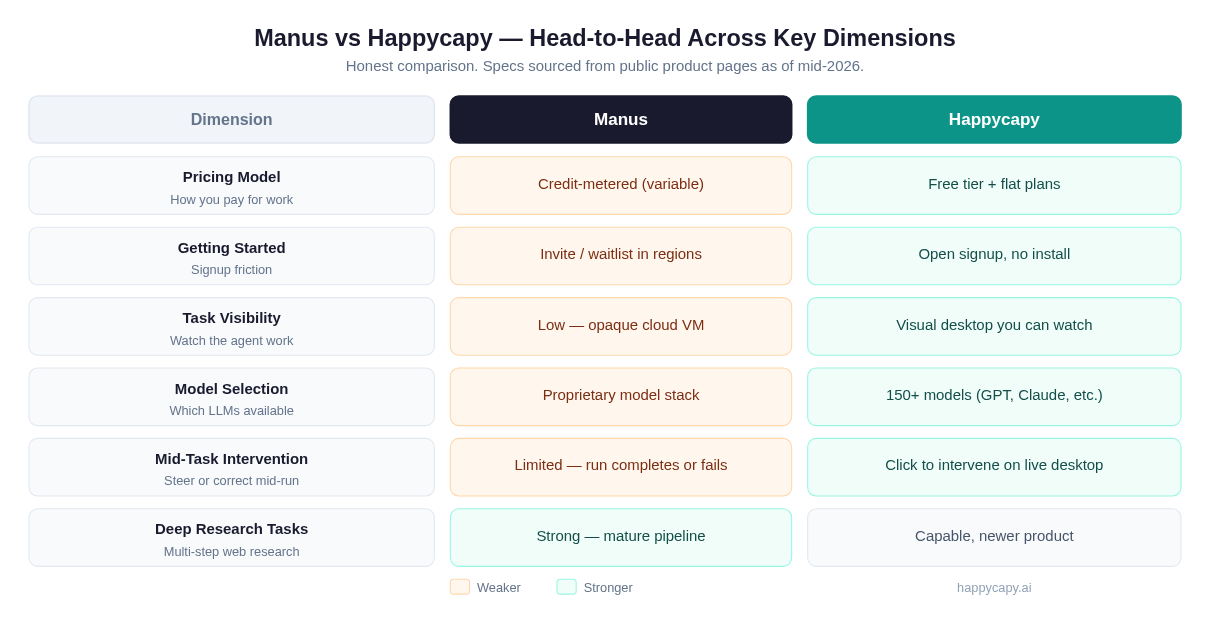 Direct comparison across the dimensions that drive most Manus switches. Specs sourced from public product pages as of mid-2026.
Let's put the comparison in plain language across the dimensions that matter most.
Pricing
Manus uses a credit system where complex tasks have variable and often unpredictable costs. Happycapy uses flat plans with a free tier. If you're optimizing for cost predictability, Happycapy wins clearly.
Getting Started
Manus still has waitlist friction in some regions and accounts. Happycapy is open signup with no install. If you need to start today, this isn't close.
Task Visibility
Manus runs in an opaque cloud VM. You submit a task and wait. Happycapy runs on a visual desktop sandbox you can watch in real time and click into when needed. For anyone doing complex or high-stakes work, the ability to watch and steer is meaningful.
Model Selection
Manus: proprietary model stack, no user control. Happycapy: 150+ models including all the major frontier models and open-source options. If model flexibility matters to you (for quality, cost, or capability matching), Happycapy wins.
Mid-Task Intervention
Manus: limited. Once a run starts, it either completes or fails. If it goes sideways, you find out at the end. Happycapy: you can click into the live desktop and redirect the agent mid-task. This is a fundamentally different interaction model for complex tasks.
Setup and Installation
Both are cloud-based with no local install required. This is a draw.
Task Breadth
Both handle general-purpose autonomous tasks: browsing, code execution, file creation, multi-step workflows. This is substantively a draw, with Manus having a longer track record on some complex research tasks and Happycapy being a newer product with rapid development.
Where Manus Still Wins
Honesty matters here. Manus isn't a bad product; it's a capable autonomous agent with a mature pipeline for specific task types. Here's where it has a genuine edge:
Deep, long-horizon research tasks. Manus has been doing autonomous multi-step research tasks since early 2025. Its pipeline for researching a topic, following citations, synthesizing results into a structured document, and handling the edge cases of long research runs is polished. If your primary use case is complex research synthesis and you have access, it's hard to beat.
Established track record. More users have put Manus through its paces over a longer period. There's more documentation of what it can and can't do, more community knowledge about how to prompt it effectively, and more edge cases it's already been tested against.
Brand recognition in the enterprise. For teams evaluating autonomous agents at scale, Manus's earlier market presence has translated into more integrations, more documented case studies, and more reference customers in some verticals.
If you're primarily doing long-horizon research tasks, you have stable Manus access, and the credit cost and black-box opacity don't bother you, there's a real argument for staying. The switch to Happycapy is most justified when you're hitting access friction, budget predictability problems, or consistently frustrated by not being able to see and steer what the agent is doing.
Migration Considerations
Switching from Manus to Happycapy is low-friction because both are browser-based, no-install tools. A few things worth thinking through:
Your prompts carry over. There's no proprietary prompt syntax in Manus that won't work in Happycapy. Whatever instructions and task descriptions you've refined in Manus, you can bring directly to Happycapy. The task framing that works for general autonomous agents works broadly.
Model selection is new behavior. In Manus, you don't choose models. In Happycapy, you can. This is an upside, but it means you'll want to spend a few tasks learning which models perform best for your typical work types. For most users, defaulting to one of the frontier models works fine from day one; the optimization comes later.
Visual oversight changes how you work. The ability to watch the agent on a live desktop changes the workflow. You'll likely find yourself being more involved early on, watching runs to build trust and understand where it excels and where it needs a nudge. Over time, most users move to a more hands-off posture for tasks they trust and stay hands-on for novel or high-stakes work. This is different from Manus's "submit and wait" model.
Free tier for validation. Because Happycapy has a real free tier, you can validate it on your actual work before committing to a paid plan. There's no reason to do a speculative migration: run your three most common task types on the free tier and see how it performs.
The Recommendation
For most people searching for a Manus alternative, the answer is Happycapy. It covers the same general-purpose autonomous agent use cases, solves the three biggest Manus friction points (access, credit predictability, black-box opacity), and lets you start immediately without installation or invitation.
If your specific problem is deep research and Manus works fine for you otherwise, Manus may still be the better tool on that task type. If you're in a region with clean Manus access and you've learned to work with the credit system, the switching cost might not be worth it.
But if you're blocked by access, frustrated by unpredictable costs, or tired of submitting a task and having no idea what happened when it fails, Happycapy is the direct, no-friction switch. Free tier, no install, 150+ models, and a desktop you can actually watch.
For broader context on the alternatives landscape (including tools optimized for research, software engineering, and open-source self-hosting), the full roundup is at Manus AI alternatives: every tool compared.
If you're also evaluating how autonomous agents fit into broader business workflows, AI agents in business: what actually works in 2026 is worth reading alongside this. And if you arrived here from an OpenClaw context, the OpenClaw alternatives guide covers the self-hosted and developer-first angle in depth.
Caveats and Honest Notes
A few things to keep in mind before deciding:
This is a fast-moving market. Manus, Happycapy, and every other tool in this category is shipping updates rapidly. Specific features and pricing may change after this was published. Check current pricing pages before committing to anything.
Happycapy is our product. Full disclosure: this post is written by Happycapy's team. We've tried to be honest about where Manus wins and where the comparison is genuinely close, but you should factor that in and check independent reviews.
No autonomous agent is fully reliable on long tasks. Manus, Happycapy, and every general-purpose autonomous agent will hallucinate, get stuck, or drift on sufficiently complex tasks. The visual oversight in Happycapy helps you catch and correct these failures, but it doesn't eliminate them. Set expectations accordingly for production-critical work.
The "best" tool depends on your task mix. If 80% of your work is deep multi-step research, Manus's pipeline strengths might outweigh the friction. If your work is more varied (some research, some coding, some file work, some forms), a general-purpose tool with model flexibility is probably the better fit.
Frequently Asked Questions
What is the best Manus alternative overall?
For most users: Happycapy. It handles the same general-purpose autonomous agent tasks, has open signup with a free tier, uses flat pricing instead of credit-metering, and runs on a visual desktop you can watch and steer. For specialized use cases (deep research only, software engineering only, or self-hosted control), see the full alternatives roundup for tools that specialize in those areas.
Is Happycapy free?
Yes. Happycapy has a free tier with genuine functionality, enough to run real tasks and evaluate the tool on your work before upgrading. Paid plans add capacity and priority model access.
Why do people leave Manus?
The most consistent reasons: access friction (waitlists and invite requirements in some regions), unpredictable credit costs on complex tasks, no ability to choose the underlying model, and limited visibility into what the agent is doing during a run. If none of these apply to you, you may not need to switch.
Can I use Claude or GPT-4o inside Happycapy?
Yes. Happycapy supports 150+ models including GPT-4o, Claude, Gemini, and a range of open-source models. You can select which model runs a given task, which lets you optimize for quality, cost, or capability depending on what you're doing.
Does switching from Manus to Happycapy require installation?
No. Both are browser-based, no-install platforms. Switching means opening a different URL and signing up; there's no migration of local files, no infrastructure to reconfigure, and no new CLI to learn.
How is Happycapy different from Manus's cloud VM?
Both run tasks in a cloud environment, but the experience is different. Manus's VM is opaque. You submit a task and get output. Happycapy's sandbox is a live visual desktop you can watch in real time: you can see what the agent is clicking, reading, and doing, and intervene at any point during a run. This makes complex task management significantly more controllable.
Where does Manus outperform Happycapy?
On deep, long-horizon research tasks, Manus has a more mature pipeline with a longer track record. If your primary use case is complex research synthesis and you have stable Manus access, it's a credible choice. Happycapy is a newer product with rapid development, and the gap narrows quickly, but as of mid-2026, Manus's research-specific depth is its strongest argument for staying.
Is this post affiliated with Manus?
No. This is written by Happycapy's team and represents our independent assessment. We're a direct competitor to Manus, not affiliated with them. We've aimed to be fair to Manus's strengths because misleading comparisons don't serve anyone, but you should read with that context in mind and check independent sources.
Where can I find a broader comparison of all the Manus alternatives?
The full roundup (including tools optimized for research, software engineering, open-source control, and no-code business automation) is at Manus AI alternatives: every tool compared. This page gives you the focused decision case; that one gives you the full landscape.